"He is no fool, to give the thing he cannot keep, to gain what he could never lose." Jim Elliot
It was these words, penned by martyred missionary Jim Elliot, that provided me with great encouragement, motivation and inspiration from 1987-1989. It was during these couple of years that I was counting "the cost" of becoming a pastor. Choosing the path of ministry looked foolish to outsiders. Why would you go to a small, obscure Bible College? How could you really believe this way? Why would you go somewhere without an athletics program? Why would you go somewhere where you'll have to work your way through school? How will you support yourself? Are you ready to live a life of poverty? What about what your friends and family and what they will think? Who's gotten into your head?
I was just a kid struggling with a call to ministry -- knowing I would disappoint people. Knowing I would be misunderstood and would potentially disillusion people who had invested dreams of their own in my life.
Yet I took hope in the promises of God. Matthew 19: 29 "And everyone who has left houses or brothers or sisters or father or mother or children or fields for my sake will receive a hundred times as much and will inherit eternal life."
Looking back on the path I took, I have no regrets. It has been tough at times, but for the most part, it has been a wonderful experience -- each step of the way. There is so much to be thankful for: Great friends, close family, a wonderful church, the best wife and kids, the list goes on and on.
Yesterday I went and saw a preview of the movie, "The End of the Spear", which recounts the amazing redemptive continuation of the story of Jim Elliot and his four missionary friends who were killed in Ecuador 50 years ago. The movie will be released on January 20, 2006 -- and I would really recommend it.
Steve Saint will be at MissionsFest, Seattle. The movie is really his story -- recounting the loss of his father as a child on the mission field, and ending with the friendship of one of the warriors responsible for his loss. It is a great story, and you'll be able to hear him first hand in October. Our church is co-hosting this event. http://www.missionsfestseattle.org/
May I encourage you again to let go of the things that keep you from pursuing God's best and His highest for your life.

Monday, November 28, 2005


Monday, November 21, 2005
(Not) Running at Nationals
Running update...Most of you know that I have been running competitively since I was seven years old. After the 2000 Olympic Trials (marathon), I began to slow down a bit. Forced to slow down actually -- by an injured knee. Then, I was working on my doctorate during that time as well. Still, in spite of "slowing down" and not having as much of a focus, I have been able to run a few good races each year since 2000. My knee healed up but I kind of enjoyed NOT having to run 2x/day and log tons of miles.
This Fall I ran Cross Country for the first time in a couple years. I was hoping to run for my team this past weekend at the National Cross Country Championships in Rochester, New York. Training was coming along well. I ran two races, and had some rapidly improving workouts. But I never recovered from the second race. Somehow I messed up my back at the Western Washington University Invitational-- this is something that has never happened before. Makes me think I might be getting old. OK -- I know that I am getting older and these things start to happen. When I was in Manila and Bangkok, it was really hurting. It took my back four weeks to heal -- long enough to lose my fitness and keep me from competing at Nationals.
Am I disappointed? A tiny bit -- but I had so many other things going on during the past six weeks, it actually was nice not to have to train hard. I kept my focus on other things.
Disappointments can always be a blessing in disguise. We just have to not focus on the disappointment. Instead focus on the new opportunities. I'm running again -- but I have yet to schedule another race. Right now I'm content to enjoy the crisp air, the fall colors, and time to think and pray. I just read the results and my team did well. Congratulations to them! And someone else was able to run in my place and have a great experience.
This Fall I ran Cross Country for the first time in a couple years. I was hoping to run for my team this past weekend at the National Cross Country Championships in Rochester, New York. Training was coming along well. I ran two races, and had some rapidly improving workouts. But I never recovered from the second race. Somehow I messed up my back at the Western Washington University Invitational-- this is something that has never happened before. Makes me think I might be getting old. OK -- I know that I am getting older and these things start to happen. When I was in Manila and Bangkok, it was really hurting. It took my back four weeks to heal -- long enough to lose my fitness and keep me from competing at Nationals.
Am I disappointed? A tiny bit -- but I had so many other things going on during the past six weeks, it actually was nice not to have to train hard. I kept my focus on other things.
Disappointments can always be a blessing in disguise. We just have to not focus on the disappointment. Instead focus on the new opportunities. I'm running again -- but I have yet to schedule another race. Right now I'm content to enjoy the crisp air, the fall colors, and time to think and pray. I just read the results and my team did well. Congratulations to them! And someone else was able to run in my place and have a great experience.
Friday, November 18, 2005
Finding God Outside of Church
The types of reading I do generall group into four categories: Study, Bible, Christian Living, and "recreational reading" (fiction). Most of my "recreational reading" goes on when I travel. I do a lot of "speed reading" when I study as part of my preparation for teaching. When I mention Bible as a category I also am thinking of some basic study tools that I use as a part of that.
During 2005 and for part of 2006 I was immersed in writing my D.Min. thesis. Because of that it's been a long time since I read a "Christian Living" book. These books tend to focus on themes related to Christian growth. Feeling a need for some further input into my walk, I picked up several books from the King County Library that I might be good.
The book that I am really enjoying right now is, Finding God in Unexpected Places, by Philip Yancey. "God is already present, in the most unexpected places. We just need to make God visible." I have enjoyed some of his books in the past -- I like his writing style and the way he thinks. This book is going to be a good one. In it he begins with a discussion on the Christian view of death and questions about why we have such a hard time facing it. It reminds me of Becker's book, The Denial of Death. This discussion reminds me of the times I have had to sit with people who are dying of have recently died -- thrust into these situations by virtue of being a Pastor. I think this helps me come to grips with my own mortality, but I still struggle with the old way of thinking -- fearing death -- whereas for us as Christians we have nothing to fear. In fact, we have something to look forward to.
Another book I picked up is Posers, Fakers & Wannabes, by Brennan Manning. This book has to do with "being yourself" or being the person God created you to be. I actually didn't like this book -- I don't think this is a BIG struggle for me -- I basically am who I am and don't try to be someone that I am not (I said basically -- I think we all struggle with this to some degree). This book might be helpful for some, but I didn't like it. There seems to be a a subtle stream of questionable content thrown into the book where the author is trying to get a reaction (occasional use of profanity), but it clashes with me. Reading Ephesians might be a better use of your time if you want to learn more about being the person God created you to be. This is the 3rd of Manning's books I've tried to read, but for some reason they don't hit home for me.
During 2005 and for part of 2006 I was immersed in writing my D.Min. thesis. Because of that it's been a long time since I read a "Christian Living" book. These books tend to focus on themes related to Christian growth. Feeling a need for some further input into my walk, I picked up several books from the King County Library that I might be good.
The book that I am really enjoying right now is, Finding God in Unexpected Places, by Philip Yancey. "God is already present, in the most unexpected places. We just need to make God visible." I have enjoyed some of his books in the past -- I like his writing style and the way he thinks. This book is going to be a good one. In it he begins with a discussion on the Christian view of death and questions about why we have such a hard time facing it. It reminds me of Becker's book, The Denial of Death. This discussion reminds me of the times I have had to sit with people who are dying of have recently died -- thrust into these situations by virtue of being a Pastor. I think this helps me come to grips with my own mortality, but I still struggle with the old way of thinking -- fearing death -- whereas for us as Christians we have nothing to fear. In fact, we have something to look forward to.
Another book I picked up is Posers, Fakers & Wannabes, by Brennan Manning. This book has to do with "being yourself" or being the person God created you to be. I actually didn't like this book -- I don't think this is a BIG struggle for me -- I basically am who I am and don't try to be someone that I am not (I said basically -- I think we all struggle with this to some degree). This book might be helpful for some, but I didn't like it. There seems to be a a subtle stream of questionable content thrown into the book where the author is trying to get a reaction (occasional use of profanity), but it clashes with me. Reading Ephesians might be a better use of your time if you want to learn more about being the person God created you to be. This is the 3rd of Manning's books I've tried to read, but for some reason they don't hit home for me.
Running Back in Time on Lime Kiln Trail
 I had the day off and was debating on whether I would head for the snow, or stick to the lowlands for a hike/run. I opted for a lowland trail-run and I discovered a great surprise in the Lime Kiln Trail outside of Granite Falls. The weather was perfect and this is a peaceful trail that is mostly flat making for a relatively easy hike or run (7 miles round-trip).
If you enjoy local history, this hike is one you'll definitely enjoy. I was found a pair of miner boots, old saw blades, a towering lime kiln, shards of china, and much more! (see my photos)All of these artifacts are scattered along the trail.
To learn more about this trail visit www.robecanyon.org


If you enjoy geocaching, it is worth noting that there are six caches along this trail.

Tuesday, November 15, 2005
Complete Notes: Ephesians 6:10-18
Ephesians 6:10-18
Introduction
The battle is real for some. (International Day of Prayer for the Persecuted Church) Faced with the real threat of persecution and danger, thousands of believers around the world worship God in fear. My encouragement to you today is to pray for them. Hebrews 13:3”Remember those in prison as if you were their fellow prisoners, and those who are mistreated as if you yourselves were suffering.” But thanks to our veterans, here in this country we have religious freedom. Consequently, the greatest expression of persecution that I might face is perhaps the rolling of someone’s eyes when they find out that I am a Christian. Living in this environment makes it easy at times, to take for granted a real, spiritual battle that’s going on.
Whether we realize it or not – whether you are a Christian or not, there is a spiritual battle for your soul and for the souls of the people around you. You have the opportunity and the responsibility to be aware of this battle, and actively involved in it.
As I prayerfully considered what my text would be for Veteran’s Day weekend, I was reminded of the fact that we are all soldiers who fight another kind of battle. This is something we teach our children, but often as adult believers, I’m afraid we’re walking around on a battlefield unaware of our surroundings – this is a dangerous place to be. Now this fact has been a source of some confusion for many, so today we are going to take a look at a passage in the book of Ephesians that describes this battle as well as our responsibility as people caught up in the middle of this spiritual struggle. It’s real. It’s important. And understanding how this works will help you find areas of victory that you otherwise will never realize -- if you take a passive approach.
The book of Ephesians describes who we are as believers because of what Jesus has done…who the church is – as a spiritual force…and then finally in the light of those two things the letter concludes with some directives as to how we are to live…One of the key ways that all believers are to live is as soldiers aware of the spiritual conflict and able to overcome the enemy with God’s strength. I have titled my message, “Armed and Victorious” – What does this mean? What does it look like for a the school teacher? For the bus driver? The parent? The single professional? The retired person? An athlete? A student?
II. Establish your strength in the Lord
Read Ephesians 6:10
As a final word – culminating this important letter is this exhortation to be empowered in the Lord and in the might of His strength.
We have a calling to “be strong”. God is calling His church to be strong. We need Christians who will be strong enough to express their faith by doing good. We need Christians who will be strong enough to make a difference in this world. Quite frankly, Christians have gained a reputation for being weak and insipid which is the opposite of strong. In what areas am I, as a human weak?
In what areas of my life do I need to be strong in the Lord? Is it fear that controls you? Is it a moral issue? Am I giving into temptation? Is it an issue of boldness? Do I hold back when God is telling me to reach out?
We have a source of strength: In the Lord and in His power: Let God be the strength of your life. Our areas of weakness are the places that He wants to bring us strength. (2 Corinthians 12:9 “My power is made perfect in weakness.” How great is His mighty power? (omnipotent – outside the measurable). This strength is not be our own natural force. But it comes from living a life in Him.
Establish your strength in the Lord – Be strong in Him.
III. Enter the right battle battlefield
Let’s read on: Read vss. 11-12
Accept the reality of the struggle
Lurking just below the surface of our lives is the reality of this spiritual warfare that is going on. Some may choose to deny it, but the word of God is clear –we must recognize this reality and engage in it. If we believe in the cross, and the Word and the resurrection and the presence of the HS that you can assume this reality.
The evil in this world has a source – spiritually. That leader the powers of evil, is the one the Bible calls the devil (the name Satan, literally means “deceiver”. He is not omnipresent. Neither is he omnipotent. He is powerful but limited in his abilities. -- Explain this hierarchy: Hierarchy of satanic influence in our world. We need not fear the reality of this dimension. Those that are in Christ are those who can actually combat these forces and the writer of Ephesians is about to tell us how to do that.
Because of the cross, Christ now reigns supreme. (The devil exercises limited influence through a network of spiritual powers. These actively hostile powers are under his leadership – we have been rescued from his domination, but we still battle)
For our hand to hand combat (struggle/wrestle) is not against flesh and blood, but against…of the darkness and the spirits of evil in the heavenlies).
Two examples of the reality of this spiritual struggle: Have you had moments when the spiritual struggle or battle became unusually clear or evident?
I think that these moments in life are allowed by God to strength our faith, solidify our faith and they are moment that He uses us to accomplish important things in the spirit. Normally, the battle takes place at another level – our will and our behavior are key elements in this struggle.
Understand the nature of our struggle: The more subtle and routine warfare that we are in has to do with the struggles with the lies that tempt us and can result in sinful and destructive choices. Behind your struggles, there are other things at work
Based on the fact of this spiritual warfare, you and I should look closely at this passage so that we will come out victorious in this struggle. Amen? We spend so much time only addressing the surface issues. I’m encouraging you today to enter the right battlefield and recognize that there is more going on in our lives than the surface issues. Don’t limit your struggle to the natural.
Take your stand/hold your ground against the schemes or methods (plans, art, skill, cunning, of the devil. What are the methods of the devil? . (Methods: the lie/deception(Father of all lies (John 8:44) -- , temptation (tempter – Matthew 4:3, 1 Thes. 3:5) , resulting in sin which then has a destructive impact). He tempts people towards evil through the lies, and then when they succumb to that temptation it results in sin – these choices are made – that is the cutting edge of the battle of spiritual warfare. Whenever we succumb to temptation and sin, we give ground to the enemy. Sin is the fulfillment of our enemies will for our lives. When we recognize the spiritual reality behind our struggles, you get to the root cause of the problem – not just the obvious symptoms of expressions of our problems.
The first step on the battlefield is making sure that you have put on the complete armor of God. Let’s be sure not to put it half way on – or to neglect any of the items listed here. Let’s look for areas we may be exposed, so that we will be able to When we “take our stand” in this way we are dealing with the source behind the issues that we struggle with. For example, when I get angry with someone I am being assaulted with the temptation to be vengeful, to hate, to wish harm upon that person. Those thought are parts of this battle, and when I act upon those thoughts, than this conflict becomes a place of victory for the enemy. But God has given us powerful tools so that we’re without excuse – we can be victorious in this struggle.
IV. Be armed and victorious!
Vss. 13-18
Be armed…
The metaphor of the armor is a powerful way of illustrating how we can stand victorious in this battle.
But remember – Paul is using a metaphor to describe how we fight this real battle. The metaphor is of a well equipped soldier. So these items are not mystical, invisible, spiritual clothes – if they are merely that than they will do you no good. They are descriptive of powerful behaviors that characterize the victorious Christian life.
Make sure your armor is complete (this is needed before you go into battle. It is the final step of preparation). Do this so that when the day of evil comes – when evil confronts you, tempts your or challenges you – you will be able to stand your ground, and the influence of evil will be stopped where you stand. The gossip ends with you. The backbiting ends with you. Destructive behaviors end with you. Greed ends with you. So after doing all the right things, you remain standing.
(Show and explain the belt) The Belt of Truth: Be truthful when it is easier to lie. If you wake up in the morning and pretend like you put on the belt of truth, but then yield to the temptation to lie, than that little exercise did you no good. Your behavior is what is really important. Victoriously hold your ground by being truthful, when lying/deceiving would be an easy cover up. The behaviors that correspond to this piece of armor and behaviors that express truth. Honesty.
The Smith’s were proud of their family tradition. Their ancestors had come to America on the Mayflower. Their line had included Senators, Pastors, & Wall Street wizards.Now they decided to compile a family history, a legacy for the children. They hired a well known author. Only one problem arose: how to handle that great-uncle George who was executed in the electric chair. But the author said not to worry, he could handle that section of history tactfully.When the book appeared, the family turned to the section on Uncle George.There, they read "George Smith occupied a chair of applied electronics at an important government institution, was attached to his position by the strongest of ties, & his death came as a real shock." We are often tempted to lie because of a fear of what people will think. We hide our secrets, and we try to make ourselves look better than we are and we quickly get ourselves into a lot of trouble. So let’s wear the belt of truth.
(Show the breastplate/flak jacket) The Breastplate of Righteousness: Doing right, when wrong is being rewarded. Victoriously hold your ground by doing right (where wrong is rewarded). To do the right thing is rarely the easy path. It is often not the politically correct path– but by developing a real history of right behaviors – including goodness, caring and serving – your life, your heart will be protected. When people are gossiping say something good.
(Feet): Good News Shoes: On your toes with the message of love and hope. Heavy-duty sandals, complete with shin guards and sometimes spikes on the soles (cleats). Be on your toes, prepared to share the hope and the good news of Jesus Christ. Are your ready? The message which you carry is the Good News that every person was created by God to be able to understand and to receive.
(Shield) The Shield of Faith: Choosing faithfulness when we are tempted. The Roman Soldier’s shield was…This shield is…Faith means that you can believing even when under attack. Be strong in your faith. Keep believing. Don’t be shaken. Be faithful, where unfaithfulness is a temptation. Your commitment to faithfulness will cause the fiery arrows of temptation to miss their mark. There are times when you will be a target for all kinds of temptations. Arrows are the deadly assaults launched and aimed at the vulnerable spaces in our armor – in our lives. Is the temptation that I am experiencing a pull towards unfaithfulness? Is it an expression of faith? Satan desires to kill, steal and destroy (John 10:10), but Jesus came that we might have life, and have it to the full.
(The helmet of salvation) A mind protected by a past, present and future salvation. Show the Roman helmets. Very heavy. Remember where you’ve come from and where you’re going. Let this be in the forefront of your mind and in your thoughts. We have a vital and essential dependency on God for salvation. Without this being in place, we are without hope. Salvation from what? Temptation. Condemnation. Danger. The thoughts of the greatness of salvation protect our minds from negative thoughts and lies. We STAND and block his influence. Where you have influence, you can make a positive difference.
(Sword of the Spirit.) Hebrews 4:12. Make the Word an indispensable part of your life. This is the only offensive weapon in your arsenal. Jesus set an example for us during His own temptation. Hebrews 4:12. 12For the word of God is living and active. Sharper than any double-edged sword, it penetrates even to dividing soul and spirit, joints and marrow; it judges the thoughts and attitudes of the heart. It is made to deliver lethal blows while in close combat. Deals with the lies and the temptation. It is the source of truth.
Pray in the Spirit: Be alert and proactive in prayer. Then, although it is not given a metaphorical illustration, he concludes this passage with what I believe is another offensive weapon that could not be adequately described as another weapon. This is the challenge to pray, and keep on praying at all times, in the Spirit. This challenge stands alone at the end of this section. Don’t fall asleep. Be watchful, and keep praying not only for yourself, but also for all the saints. Pray for your church. Pray for your family. Pray for other believers.
Conclusion
STAND (Remain engaged in the battle) – Tell the story of the Vietnam War medal of honor recipient from Hill 488. holding his position. Keep fighting. So mothers – keep praying of your children and don’t give up on them. Singles who are lonely and are thinking about giving up on Christianity because it would be so much easier if you did – STAND. Fathers—Businessmen: -- Retired people – STAND.
Stop his methods
Standing isn’t going into battle wildly swinging the sword. But it is a picture of taking maintaining ground wherever you go. “Resist the devil and he will flee from you.” (James 4:7)
In what areas of your life do you need to be strong in the Lord and in His mighty power?
Ephesians 1:18-19 “I pray also that the eyes of your heart may be enlightened in order that you may know the hope to which he has called you, the riches of his glorious inheritance in the saints, and his incomparably great power for us who believe.”
Introduction
The battle is real for some. (International Day of Prayer for the Persecuted Church) Faced with the real threat of persecution and danger, thousands of believers around the world worship God in fear. My encouragement to you today is to pray for them. Hebrews 13:3”Remember those in prison as if you were their fellow prisoners, and those who are mistreated as if you yourselves were suffering.” But thanks to our veterans, here in this country we have religious freedom. Consequently, the greatest expression of persecution that I might face is perhaps the rolling of someone’s eyes when they find out that I am a Christian. Living in this environment makes it easy at times, to take for granted a real, spiritual battle that’s going on.
Whether we realize it or not – whether you are a Christian or not, there is a spiritual battle for your soul and for the souls of the people around you. You have the opportunity and the responsibility to be aware of this battle, and actively involved in it.
As I prayerfully considered what my text would be for Veteran’s Day weekend, I was reminded of the fact that we are all soldiers who fight another kind of battle. This is something we teach our children, but often as adult believers, I’m afraid we’re walking around on a battlefield unaware of our surroundings – this is a dangerous place to be. Now this fact has been a source of some confusion for many, so today we are going to take a look at a passage in the book of Ephesians that describes this battle as well as our responsibility as people caught up in the middle of this spiritual struggle. It’s real. It’s important. And understanding how this works will help you find areas of victory that you otherwise will never realize -- if you take a passive approach.
The book of Ephesians describes who we are as believers because of what Jesus has done…who the church is – as a spiritual force…and then finally in the light of those two things the letter concludes with some directives as to how we are to live…One of the key ways that all believers are to live is as soldiers aware of the spiritual conflict and able to overcome the enemy with God’s strength. I have titled my message, “Armed and Victorious” – What does this mean? What does it look like for a the school teacher? For the bus driver? The parent? The single professional? The retired person? An athlete? A student?
II. Establish your strength in the Lord
Read Ephesians 6:10
As a final word – culminating this important letter is this exhortation to be empowered in the Lord and in the might of His strength.
We have a calling to “be strong”. God is calling His church to be strong. We need Christians who will be strong enough to express their faith by doing good. We need Christians who will be strong enough to make a difference in this world. Quite frankly, Christians have gained a reputation for being weak and insipid which is the opposite of strong. In what areas am I, as a human weak?
In what areas of my life do I need to be strong in the Lord? Is it fear that controls you? Is it a moral issue? Am I giving into temptation? Is it an issue of boldness? Do I hold back when God is telling me to reach out?
We have a source of strength: In the Lord and in His power: Let God be the strength of your life. Our areas of weakness are the places that He wants to bring us strength. (2 Corinthians 12:9 “My power is made perfect in weakness.” How great is His mighty power? (omnipotent – outside the measurable). This strength is not be our own natural force. But it comes from living a life in Him.
Establish your strength in the Lord – Be strong in Him.
III. Enter the right battle battlefield
Let’s read on: Read vss. 11-12
Accept the reality of the struggle
Lurking just below the surface of our lives is the reality of this spiritual warfare that is going on. Some may choose to deny it, but the word of God is clear –we must recognize this reality and engage in it. If we believe in the cross, and the Word and the resurrection and the presence of the HS that you can assume this reality.
The evil in this world has a source – spiritually. That leader the powers of evil, is the one the Bible calls the devil (the name Satan, literally means “deceiver”. He is not omnipresent. Neither is he omnipotent. He is powerful but limited in his abilities. -- Explain this hierarchy: Hierarchy of satanic influence in our world. We need not fear the reality of this dimension. Those that are in Christ are those who can actually combat these forces and the writer of Ephesians is about to tell us how to do that.
Because of the cross, Christ now reigns supreme. (The devil exercises limited influence through a network of spiritual powers. These actively hostile powers are under his leadership – we have been rescued from his domination, but we still battle)
For our hand to hand combat (struggle/wrestle) is not against flesh and blood, but against…of the darkness and the spirits of evil in the heavenlies).
Two examples of the reality of this spiritual struggle: Have you had moments when the spiritual struggle or battle became unusually clear or evident?
I think that these moments in life are allowed by God to strength our faith, solidify our faith and they are moment that He uses us to accomplish important things in the spirit. Normally, the battle takes place at another level – our will and our behavior are key elements in this struggle.
Understand the nature of our struggle: The more subtle and routine warfare that we are in has to do with the struggles with the lies that tempt us and can result in sinful and destructive choices. Behind your struggles, there are other things at work
Based on the fact of this spiritual warfare, you and I should look closely at this passage so that we will come out victorious in this struggle. Amen? We spend so much time only addressing the surface issues. I’m encouraging you today to enter the right battlefield and recognize that there is more going on in our lives than the surface issues. Don’t limit your struggle to the natural.
Take your stand/hold your ground against the schemes or methods (plans, art, skill, cunning, of the devil. What are the methods of the devil? . (Methods: the lie/deception(Father of all lies (John 8:44) -- , temptation (tempter – Matthew 4:3, 1 Thes. 3:5) , resulting in sin which then has a destructive impact). He tempts people towards evil through the lies, and then when they succumb to that temptation it results in sin – these choices are made – that is the cutting edge of the battle of spiritual warfare. Whenever we succumb to temptation and sin, we give ground to the enemy. Sin is the fulfillment of our enemies will for our lives. When we recognize the spiritual reality behind our struggles, you get to the root cause of the problem – not just the obvious symptoms of expressions of our problems.
The first step on the battlefield is making sure that you have put on the complete armor of God. Let’s be sure not to put it half way on – or to neglect any of the items listed here. Let’s look for areas we may be exposed, so that we will be able to When we “take our stand” in this way we are dealing with the source behind the issues that we struggle with. For example, when I get angry with someone I am being assaulted with the temptation to be vengeful, to hate, to wish harm upon that person. Those thought are parts of this battle, and when I act upon those thoughts, than this conflict becomes a place of victory for the enemy. But God has given us powerful tools so that we’re without excuse – we can be victorious in this struggle.
IV. Be armed and victorious!
Vss. 13-18
Be armed…
The metaphor of the armor is a powerful way of illustrating how we can stand victorious in this battle.
But remember – Paul is using a metaphor to describe how we fight this real battle. The metaphor is of a well equipped soldier. So these items are not mystical, invisible, spiritual clothes – if they are merely that than they will do you no good. They are descriptive of powerful behaviors that characterize the victorious Christian life.
Make sure your armor is complete (this is needed before you go into battle. It is the final step of preparation). Do this so that when the day of evil comes – when evil confronts you, tempts your or challenges you – you will be able to stand your ground, and the influence of evil will be stopped where you stand. The gossip ends with you. The backbiting ends with you. Destructive behaviors end with you. Greed ends with you. So after doing all the right things, you remain standing.
(Show and explain the belt) The Belt of Truth: Be truthful when it is easier to lie. If you wake up in the morning and pretend like you put on the belt of truth, but then yield to the temptation to lie, than that little exercise did you no good. Your behavior is what is really important. Victoriously hold your ground by being truthful, when lying/deceiving would be an easy cover up. The behaviors that correspond to this piece of armor and behaviors that express truth. Honesty.
The Smith’s were proud of their family tradition. Their ancestors had come to America on the Mayflower. Their line had included Senators, Pastors, & Wall Street wizards.Now they decided to compile a family history, a legacy for the children. They hired a well known author. Only one problem arose: how to handle that great-uncle George who was executed in the electric chair. But the author said not to worry, he could handle that section of history tactfully.When the book appeared, the family turned to the section on Uncle George.There, they read "George Smith occupied a chair of applied electronics at an important government institution, was attached to his position by the strongest of ties, & his death came as a real shock." We are often tempted to lie because of a fear of what people will think. We hide our secrets, and we try to make ourselves look better than we are and we quickly get ourselves into a lot of trouble. So let’s wear the belt of truth.
(Show the breastplate/flak jacket) The Breastplate of Righteousness: Doing right, when wrong is being rewarded. Victoriously hold your ground by doing right (where wrong is rewarded). To do the right thing is rarely the easy path. It is often not the politically correct path– but by developing a real history of right behaviors – including goodness, caring and serving – your life, your heart will be protected. When people are gossiping say something good.
(Feet): Good News Shoes: On your toes with the message of love and hope. Heavy-duty sandals, complete with shin guards and sometimes spikes on the soles (cleats). Be on your toes, prepared to share the hope and the good news of Jesus Christ. Are your ready? The message which you carry is the Good News that every person was created by God to be able to understand and to receive.
(Shield) The Shield of Faith: Choosing faithfulness when we are tempted. The Roman Soldier’s shield was…This shield is…Faith means that you can believing even when under attack. Be strong in your faith. Keep believing. Don’t be shaken. Be faithful, where unfaithfulness is a temptation. Your commitment to faithfulness will cause the fiery arrows of temptation to miss their mark. There are times when you will be a target for all kinds of temptations. Arrows are the deadly assaults launched and aimed at the vulnerable spaces in our armor – in our lives. Is the temptation that I am experiencing a pull towards unfaithfulness? Is it an expression of faith? Satan desires to kill, steal and destroy (John 10:10), but Jesus came that we might have life, and have it to the full.
(The helmet of salvation) A mind protected by a past, present and future salvation. Show the Roman helmets. Very heavy. Remember where you’ve come from and where you’re going. Let this be in the forefront of your mind and in your thoughts. We have a vital and essential dependency on God for salvation. Without this being in place, we are without hope. Salvation from what? Temptation. Condemnation. Danger. The thoughts of the greatness of salvation protect our minds from negative thoughts and lies. We STAND and block his influence. Where you have influence, you can make a positive difference.
(Sword of the Spirit.) Hebrews 4:12. Make the Word an indispensable part of your life. This is the only offensive weapon in your arsenal. Jesus set an example for us during His own temptation. Hebrews 4:12. 12For the word of God is living and active. Sharper than any double-edged sword, it penetrates even to dividing soul and spirit, joints and marrow; it judges the thoughts and attitudes of the heart. It is made to deliver lethal blows while in close combat. Deals with the lies and the temptation. It is the source of truth.
Pray in the Spirit: Be alert and proactive in prayer. Then, although it is not given a metaphorical illustration, he concludes this passage with what I believe is another offensive weapon that could not be adequately described as another weapon. This is the challenge to pray, and keep on praying at all times, in the Spirit. This challenge stands alone at the end of this section. Don’t fall asleep. Be watchful, and keep praying not only for yourself, but also for all the saints. Pray for your church. Pray for your family. Pray for other believers.
Conclusion
STAND (Remain engaged in the battle) – Tell the story of the Vietnam War medal of honor recipient from Hill 488. holding his position. Keep fighting. So mothers – keep praying of your children and don’t give up on them. Singles who are lonely and are thinking about giving up on Christianity because it would be so much easier if you did – STAND. Fathers—Businessmen: -- Retired people – STAND.
Stop his methods
Standing isn’t going into battle wildly swinging the sword. But it is a picture of taking maintaining ground wherever you go. “Resist the devil and he will flee from you.” (James 4:7)
In what areas of your life do you need to be strong in the Lord and in His mighty power?
Ephesians 1:18-19 “I pray also that the eyes of your heart may be enlightened in order that you may know the hope to which he has called you, the riches of his glorious inheritance in the saints, and his incomparably great power for us who believe.”
Tuesday, November 08, 2005
Afraid to Come Home
It was a dry, cold December night. Frost and unmelted snow covered my yard there in Bend, Oregon. I was a Junior at Bend High, and as I stood outside on our concrete porch I was afraid to open the front door. Sitting in our driveway behind me was our family car – a late model sedan, which, thanks to me the driver, had just broadsided a parked industrial truck. The mangled side mirror hung by a wire. Several dents and scratches now decorated the side of the car. The icy road had gotten the best of me.
After getting enough courage to open the door I realized my parents were asleep. So then I found myself outside their bedroom door listening to myself breath for about an hour. I knew that my father would be angry (even though he was a nice guy).
Finally I mustered up enough guts to open the door and break the news…
Have you ever felt this way with God? Harboring feelings of failure or a fear of disappointment – you distance yourself from Him, afraid to face Him or hoping to do something better that would merit his approval. You stand on the outside afraid to come in. As long as you stand out in the cold, you have forgotten something:
Ephesians 2:8-10 (New International Version) says, “8For it is by grace you have been saved, through faith—and this not from yourselves, it is the gift of God— 9not by works, so that no one can boast. 10For we are God's workmanship, created in Christ Jesus to do good works, which God prepared in advance for us to do.”
This is the Good News! There is no condemnation for those that are in Christ Jesus! We have nothing to fear when we come to Him! He runs to greet anyone that would incline their heart towards Him.
So today, don’t be afraid of your heavenly Father. Come home to Him – He promises to welcome you in. Oh, and by the way, my dad was pretty easy on me after all.
After getting enough courage to open the door I realized my parents were asleep. So then I found myself outside their bedroom door listening to myself breath for about an hour. I knew that my father would be angry (even though he was a nice guy).
Finally I mustered up enough guts to open the door and break the news…
Have you ever felt this way with God? Harboring feelings of failure or a fear of disappointment – you distance yourself from Him, afraid to face Him or hoping to do something better that would merit his approval. You stand on the outside afraid to come in. As long as you stand out in the cold, you have forgotten something:
Ephesians 2:8-10 (New International Version) says, “8For it is by grace you have been saved, through faith—and this not from yourselves, it is the gift of God— 9not by works, so that no one can boast. 10For we are God's workmanship, created in Christ Jesus to do good works, which God prepared in advance for us to do.”
This is the Good News! There is no condemnation for those that are in Christ Jesus! We have nothing to fear when we come to Him! He runs to greet anyone that would incline their heart towards Him.
So today, don’t be afraid of your heavenly Father. Come home to Him – He promises to welcome you in. Oh, and by the way, my dad was pretty easy on me after all.
Monday, November 07, 2005
The Friendless Christian Leader
It's been exactly six months since I graduated from Gordon-Conwell with my D.Min. I have taught on my topic once or twice since then, but somewhere back in my mind I know that I need to pick it up again and find out if there is a way to find a greater distribution for my thesis. The big hurdle is taking it from an academic format and re-working into a more popular format. Pray that I would find the motivation to take this task on. Maybe your feedback will help me get going.
I have attached most of my first chapter below. Let me know what your thoughts are.
CHAPTER ONE -- INTRODUCTION
A great deal has been written on the importance and effectiveness of “servant leadership”, based on the ministry and model of Jesus. Servant leadership is important, and has become a well-developed leadership principle within the Church and even in the business community. But Jesus didn’t stop with “servant leadership”. He took leadership with the disciples to the next level when he stated, “I no longer call you servants, because a servant does not know his master's business. Instead, I have called you friends, for everything that I learned from my Father I have made known to you.” (John 15:15 -- NIV). This is the key verse of this thesis. There has been an unfortunate tendency to stop at servant leadership as if it was the final destiny of leadership. When this is done, leadership remains emotionally safe, but effectively distant from the place of maximum impact. This thesis will demonstrate how the ingredient of friendship is essential to maximum influence in the lives of others. The development of this idea will answer the question of, “How does leadership that incorporates friendship result in increased effectiveness?”
Rationale for the Project
Friends are perhaps the most powerful influencers in the world. They often exercise greater power over individuals than family, bosses and political powers. Their influence is very personal, current, active and takes place within the immediate context of life. Their care, their touch and their encouragement, all come together to form a powerful culture that shapes decisions, behavior and psychological and spiritual perspective. Consequently, friends affect behavior within businesses, churches, families and all other networks of people. Within the fabric of society, friendships form an informal network of power that has scarcely been acknowledged. These networks have formed partnerships creating some of the greatest corporations. They also constitute the fabric of the networks of volunteers in charities, sports, schools, churches and just about every organization that exists.
It was Jesus who modeled a leadership style that made friendship the central point of relationship from which His influence sprang forth. It is this powerful component of His leadership that this paper will develop.
People today are looking for caring and approachable leaders. They are looking for relational leaders with whom they will have a sense of walking on a mutually shared path. This is a subject of particular relevance for Christian leaders. Pastors have become isolated from friendship, and have often been taught to keep “safely distant” from the people they lead and serve. Because of this, these leaders are often left isolated, lonely, and out of touch from the real needs of people. Not surprisingly, H.B London Jr. has found that “most members of the clergy feel isolated, insecure, and only rarely affirmed.”[1] This paper will challenge the ideas that militate against the formation of friendships while examining their origin as well as their validity.
A leader’s ability to influence, as well as the respect that people have for them, are both enhanced through a sincere, caring and authentic relationship. The greatest influencers in the lives of people go beyond the boundaries of professionalism. The relationships that influence the most include caring and sharing at a heart-felt, real-life level. It is unfortunate that friendship as an important and indispensable aspect of leadership, has not only been overlooked, but also shunned.
This thesis is an appeal to return to a value of friendship that has been largely forgotten by modern, Western civilization. “No one,” wrote Aristotle in his Nicomachean Ethics, “would choose to live without friends, even if he had all other goods.”[2] Although this may have been true in Aristotle’s day, in the 21st century, Western culture is full of people who live without friends and instead spend their days in the pursuit of “all other goods”. Aristotle, like many of the ancient philosophers, classified philia as one of the highest virtues of life. He linked it to the fabric of the state, politics and society. Plato, Epictetus and Cicero also devoted writings to the subject of friendship. To the Stoics and the Epicureans, friendship was a virtue that made life worth living. Friendship was “the foundation of the Greek city state, and in the earlier period of the Roman empire it was the ‘glue’ that bound men, cities, and the world together…All the classical schools argued that thought was meaningless without action, but action was meaningless without the fruition of friendships.”[3] Today friendship is viewed as a luxury of society rather than the fabric upon which it is built and maintained.
Somehow Christians have failed to give friendship its rightful emphasis in writing, preaching and practice. C.S. Lewis makes an interesting observation of the role of friendship within the history of western society: “According to the Ancients, Friendship seemed the happiest and most fully human of all loves; the crown of life in the school of virtue. The modern world, in comparison, ignores it.”[4]
Today there is a movement to no longer ignore the value and the virtue of friendship. Post-moderns are seeking deeper relationships and place a much higher value on friendship than previous generations. This relational emphasis has application and expression in multiple levels of life. It not only characterizes a new generation, but also has become the expressed longing of a society that has become increasingly distant from one another. Leaders are in a position to address these challenges. The Church is the place where friendship can be taught, modeled and received. This expresses the cry of the heart of our society for deeper relationships. The intent of this thesis is to develop during this critical time in the current cultural atmosphere.
People are longing for intimacy – but the skills of healthy relationships are often neglected, leading to “safer” forms of intimacy such as email, chatting and instant messaging. These mediums have created a way to have “safe” relationships. But they are poor substitutes for “real” relationships. The answer to this human longing is a renaissance of friendship, modeled and taught be leaders who can see this need met in the way that God has designed.
Intended Outcome
The purpose of this thesis is to develop the idea that the most effective leadership in the church includes the ingredient of friendship. It will develop various aspects of this idea in order to present a clear case for the importance of this value. The intended outcome hope of this project is to bring the value of friendship to the forefront of the thinking of church leaders by developing this idea as it applies theologically, organizationally and philosophically. The end result will be the development of a leadership principle that will help leaders be more effective by becoming intentional in helping others find ways of allowing friendship to flourish.
This paper will show the fundamental need for friendship to be incorporated into Christian leadership paradigms, based on an examination of Scripture, particularly the life and teachings of Jesus Christ. This paper will examine the biblical mandate of friendship and offer a call to leaders to both implement and encourage its practice.
This paper will examine the reasons behind teachings that discourage leaders from engaging in friendship, and how leaders’ effectiveness has been thwarted through this misconception.
This thesis sets out to develop and prove the idea that leadership that cares by incorporating the qualities of friendship, is more effective than leadership that does not. “Leadership that cares: How intentional friendship revolutionizes leadership,” will define friendship for the context of leadership. It will look at how friendship with God, with self, and with others is all-important. This paper will primarily examine how friendship with others is at the center of one’s ability to be an effective leader.
[1] Mills, K. (1996). Who Ministers to the Minister? Pastor's Family Magazine.
[2] Aristotle (1962). Nicomachean Ethics. Indianapolis, Bobbs-Merrill.
[3] Houston, J. (1989). The Transforming Friendship. Oxford, Lion Publishing.
[4] Lewis, C. S. (1988). The Four Loves. Orlando, Harcourt Brace & Company.
I have attached most of my first chapter below. Let me know what your thoughts are.
CHAPTER ONE -- INTRODUCTION
A great deal has been written on the importance and effectiveness of “servant leadership”, based on the ministry and model of Jesus. Servant leadership is important, and has become a well-developed leadership principle within the Church and even in the business community. But Jesus didn’t stop with “servant leadership”. He took leadership with the disciples to the next level when he stated, “I no longer call you servants, because a servant does not know his master's business. Instead, I have called you friends, for everything that I learned from my Father I have made known to you.” (John 15:15 -- NIV). This is the key verse of this thesis. There has been an unfortunate tendency to stop at servant leadership as if it was the final destiny of leadership. When this is done, leadership remains emotionally safe, but effectively distant from the place of maximum impact. This thesis will demonstrate how the ingredient of friendship is essential to maximum influence in the lives of others. The development of this idea will answer the question of, “How does leadership that incorporates friendship result in increased effectiveness?”
Rationale for the Project
Friends are perhaps the most powerful influencers in the world. They often exercise greater power over individuals than family, bosses and political powers. Their influence is very personal, current, active and takes place within the immediate context of life. Their care, their touch and their encouragement, all come together to form a powerful culture that shapes decisions, behavior and psychological and spiritual perspective. Consequently, friends affect behavior within businesses, churches, families and all other networks of people. Within the fabric of society, friendships form an informal network of power that has scarcely been acknowledged. These networks have formed partnerships creating some of the greatest corporations. They also constitute the fabric of the networks of volunteers in charities, sports, schools, churches and just about every organization that exists.
It was Jesus who modeled a leadership style that made friendship the central point of relationship from which His influence sprang forth. It is this powerful component of His leadership that this paper will develop.
People today are looking for caring and approachable leaders. They are looking for relational leaders with whom they will have a sense of walking on a mutually shared path. This is a subject of particular relevance for Christian leaders. Pastors have become isolated from friendship, and have often been taught to keep “safely distant” from the people they lead and serve. Because of this, these leaders are often left isolated, lonely, and out of touch from the real needs of people. Not surprisingly, H.B London Jr. has found that “most members of the clergy feel isolated, insecure, and only rarely affirmed.”[1] This paper will challenge the ideas that militate against the formation of friendships while examining their origin as well as their validity.
A leader’s ability to influence, as well as the respect that people have for them, are both enhanced through a sincere, caring and authentic relationship. The greatest influencers in the lives of people go beyond the boundaries of professionalism. The relationships that influence the most include caring and sharing at a heart-felt, real-life level. It is unfortunate that friendship as an important and indispensable aspect of leadership, has not only been overlooked, but also shunned.
This thesis is an appeal to return to a value of friendship that has been largely forgotten by modern, Western civilization. “No one,” wrote Aristotle in his Nicomachean Ethics, “would choose to live without friends, even if he had all other goods.”[2] Although this may have been true in Aristotle’s day, in the 21st century, Western culture is full of people who live without friends and instead spend their days in the pursuit of “all other goods”. Aristotle, like many of the ancient philosophers, classified philia as one of the highest virtues of life. He linked it to the fabric of the state, politics and society. Plato, Epictetus and Cicero also devoted writings to the subject of friendship. To the Stoics and the Epicureans, friendship was a virtue that made life worth living. Friendship was “the foundation of the Greek city state, and in the earlier period of the Roman empire it was the ‘glue’ that bound men, cities, and the world together…All the classical schools argued that thought was meaningless without action, but action was meaningless without the fruition of friendships.”[3] Today friendship is viewed as a luxury of society rather than the fabric upon which it is built and maintained.
Somehow Christians have failed to give friendship its rightful emphasis in writing, preaching and practice. C.S. Lewis makes an interesting observation of the role of friendship within the history of western society: “According to the Ancients, Friendship seemed the happiest and most fully human of all loves; the crown of life in the school of virtue. The modern world, in comparison, ignores it.”[4]
Today there is a movement to no longer ignore the value and the virtue of friendship. Post-moderns are seeking deeper relationships and place a much higher value on friendship than previous generations. This relational emphasis has application and expression in multiple levels of life. It not only characterizes a new generation, but also has become the expressed longing of a society that has become increasingly distant from one another. Leaders are in a position to address these challenges. The Church is the place where friendship can be taught, modeled and received. This expresses the cry of the heart of our society for deeper relationships. The intent of this thesis is to develop during this critical time in the current cultural atmosphere.
People are longing for intimacy – but the skills of healthy relationships are often neglected, leading to “safer” forms of intimacy such as email, chatting and instant messaging. These mediums have created a way to have “safe” relationships. But they are poor substitutes for “real” relationships. The answer to this human longing is a renaissance of friendship, modeled and taught be leaders who can see this need met in the way that God has designed.
Intended Outcome
The purpose of this thesis is to develop the idea that the most effective leadership in the church includes the ingredient of friendship. It will develop various aspects of this idea in order to present a clear case for the importance of this value. The intended outcome hope of this project is to bring the value of friendship to the forefront of the thinking of church leaders by developing this idea as it applies theologically, organizationally and philosophically. The end result will be the development of a leadership principle that will help leaders be more effective by becoming intentional in helping others find ways of allowing friendship to flourish.
This paper will show the fundamental need for friendship to be incorporated into Christian leadership paradigms, based on an examination of Scripture, particularly the life and teachings of Jesus Christ. This paper will examine the biblical mandate of friendship and offer a call to leaders to both implement and encourage its practice.
This paper will examine the reasons behind teachings that discourage leaders from engaging in friendship, and how leaders’ effectiveness has been thwarted through this misconception.
This thesis sets out to develop and prove the idea that leadership that cares by incorporating the qualities of friendship, is more effective than leadership that does not. “Leadership that cares: How intentional friendship revolutionizes leadership,” will define friendship for the context of leadership. It will look at how friendship with God, with self, and with others is all-important. This paper will primarily examine how friendship with others is at the center of one’s ability to be an effective leader.
[1] Mills, K. (1996). Who Ministers to the Minister? Pastor's Family Magazine.
[2] Aristotle (1962). Nicomachean Ethics. Indianapolis, Bobbs-Merrill.
[3] Houston, J. (1989). The Transforming Friendship. Oxford, Lion Publishing.
[4] Lewis, C. S. (1988). The Four Loves. Orlando, Harcourt Brace & Company.
Sunday, November 06, 2005
My Adventures With Lasse
Heidi and I enjoyed this experience several years ago.
My Adventures With Lasse
by Michaek Sandrock
Eino cackles as the temperature in Lasse Viren's sauna gets hotter and hotter. Soon, sweat is beading up on our bodies, and I have a vaguely uncomfortable feeling that I may never get out alive. Viren takes a scoop from a wooden bucket and pours water on the rocks, making the heat even more intense. Eino stands on the top bench to get closer to the ceiling, where it's the hottest, and I wonder at what temperature blood begins boiling. Through a small window, I see pine trees waving invitingly. "Get up here!" Eino yells. "What are you, some kind of vimp?" I look pleadingly over at Viren, who simply shakes his head. "This is the old-style kind of sauna. It's woodburning, not electric," Viren says, explaining how he heated the rocks for several hours with a wood fire, allowing the heat to build gradually and giving the air a nice smell. "It's much better."
Finally Viren opens the sauna door, and we run across the grass and jump in the lake, feeling the clear water cool us down. After swimming for a bit, we climb out and towel off. Viren smiles. "Now you know what a real Finnish sauna is like." And after taking a Finnair Sports Tour to the 22nd annual Lassen Hölkkä - Lasse's Run - we know what Lasse Viren and Finland are like. There were 17 of us at Viren's brick house on the lake outside the small Finnish village of Myrskylä this September afternoon. Earlier in the day we had been among the 1,000 people taking part in one of the most famous races in Finland. Lassen Hölkkä was started in 1974 to honor Viren's 5,000- and 10,000-meter gold medals in the 1972 Munich Olympic Games. The race has been held yearly ever since, and Viren always runs, though he no longer wins (as he did three times). Past runners include Miruts Yifter, Gaston Roelants, Emiel Puttemans - and now us.
The highlight of the 10-day tour - which also included the Berlin Marathon - was this chance for a rare look at Viren, one of the all-time greats of running. As is true for Bill Rodgers or Frank Shorter, Viren's first name is enough to identify him; say "Lasse" in Finland and everyone knows whom you're talking about. Myrskylä, Myrskylä - the town is one of the most mysterious in running lore. For years I'd heard about it, as some kind of far-off sorcerer's realm in Finland, and now we were on our way there.
Some of us were a bit intimidated at the thought of meeting Viren, who has a reputation of being somewhat of a loner. We weren't alone in our feelings. Bill Rodgers, in his book Marathoning, writes, "I have beaten Viren several times since he won gold medals for the second time in the 5,000 and 10,000, but I still hold him in awe. I feel apprehensive about going near him. Is this man for real? He's a superman, almost. Yet he doesn't act that way at all."
The group took a bus to Myrskylä, complete with a video showing some of Viren's four Olympic victories. We passed tidy farms and endless miles of dirt and gravel trails through the pine and birch forests. The starting area for the race was a large field next to the clubhouse, or Kiparkatti, of Myrskylän Myrsky [Stormville Stormers], the running club Viren has belonged to since he was a teenager. Viren traveled around the world many times, but he always returned to Myrskylä, and you can see why. He is well known there, and there is a real sense of community in the town.
We stand amidst the Finnish runners, stretching and talking, when all at once, there he is, Lasse Viren, looking much like he did in his glorious Olympic victories: long-legged, gaunt, lean, sporting a beard. He's wearing sweats, walking around talking to runners, making last-minute arrangements.
He comes over to the group and asks me, "Which are you running, the 10- or 20K?"
"Neither. I didn't bring my shoes."
"You didn't come all this way to watch!" bellows Eino, a well-known sculptor who was Viren's manager in the U.S. for many years. "What size shoe do you wear?"
"Ten."
"Hey, Lasse. Do you have any extra shoes?" Viren rummages around in the back of his late-model Peugeot and pulls out a pair of pale-blue Asics. I sit down and pull on the shoes. They are a little tight, but hey, they're Lasse Viren's shoes, and suddenly I'm ready to rumble.
Lassen HölkkäSo when the gun goes off, there I am, running down the road in the large pack, checking out the runners next to me. We turn onto a forest path and I take a deep breath, thinking, "Yes, we're running in Finland, land of Paavo Nurmi, Ville Ritola, Hannes Kolehmainen, Lasse Viren. We're back at the roots of running!" We pass through Myrskylä, where a bust of Viren overlooks a lake. When three Finns pass me, I look down at Lasse's shoes and go with them. Like Dorothy's ruby slippers in Oz, the shoes seem to give me more power. I feel good, strong, and fast - until I realize I'm going downhill. On the uphill, the others steadily pull away, and instead of staying with them I begin looking at the changing colors in the trees.
These are the trails where Viren prepared for three Olympic Games training countless miles under the watchful eye of coach Rolf Haikkola, now retired and waiting back at the clubhouse. Viren never did much track work; one of his toughest workouts was hill repeats near the race course. And here we are, running up his trails, through quiet pine forests, then onto the road back through Myrskyla, past a cinder track and the bust of Viren. When a flying Finn tries to pass me near the end, I click my heels and sprint, finishing in 34:30, roughly 20th place. The main event is the 20K, which is even prettier, those running it tell me. Oregon's Matt Messner, who earned the trip to Lasse's Run by winning its sister race in Coos Bay, comes down the last hill, makes the turn into the finishing straight in the lead. But he is outkicked by a former Finnish Olympic steeplechaser. Viren comes in several minutes later, looking smooth as ever.
"It was OK," Viren says. "I've only run once since the Stockholm marathon [in June], because of an injury."
LASSE'S HOUSEThe awards ceremony is held in the Kiparkatti, where Viren's 1972 Olympic 10,000-meter medal is on display. Every finisher gets an imitation Olympic medal. Afterwards, we pile in the bus and drive through town to Viren's home. The sauna is in a separate building that looks like a small house. Built by locals for Viren after his first Olympic victories, it has a kitchen and a large waiting room with a table and chairs. You sense immediately upon walking in that the sauna is something special in Finland. The women take the first sauna. Michelle LeBrun, who ran her first 10K while on the trip, says, "I was a little shy at first, but then you start to feel comfortable. Someone told me, If you don't take that towel off, you're going to be real hot. It was great when I took the plunge into the 40-degree water.
While waiting for the women to finish, the men in the group sit and talk with Viren and friend Seppo Pukkila, who has stopped by after running the Lassen Hölkkä. We pepper them with questions about the old days of Finnish running. There was great depth in Finland. Pukkila ran 29 minutes and was ranked only 30th in the country. There were many others chasing Viren in the 1970s, including Martti Vainio, Juha "The Cruel" Vddtdinen, and Seppo Tuominen. But Viren was something special, says Pukkila. "He wanted to win the Olympics above all else. That's the main reason he was so good." "Lasse never talked much about his training," recalls his wife Päivi, a teacher in Helsinki. "No matter what the weather, he just went out and ran. He never complained or missed a workout." What about food? "No, he had no special diet. Lasse ate everything, including meat."
Soon it's our turn for the sauna. As we go in, Viren says, "I often took saunas to relax after a workout, but never before a race. It could be too relaxing." He's right, and it feels so good that I repeat the process a second time, enjoying the contrast of heat and cold as I jump into the lake.
After dressing, we go into the house, where Päivi has prepared a spread. We sit and talk, drink coffee, and have "goodies," as Eino calls Finnish pastries. The house has a cultured yet comfortable air. There's a warm, cozy kitchen, paintings and etchings on the walls, soft leather couches, and lots of crystal (often given as prizes in Finland).
"I was sitting on the couch," says LeBrun, "when Lasse came and sat down next to me. Oh my god, that's Lasse Viren, I thought. I froze. But then he started chatting with us, and I saw that he was a regular guy.
You don't realize that until you get the chance to meet him, because he's such a famous guy."
The trophy room The highlight for the hardcore runners in the group comes when we gravitate toward a small room in the back of the house where Viren keeps his trophies. The room is packed with medals, cups, and trophies. "You see," says Eino, "sometimes people in the U.S. say, "Oh, Lasse didn't do anything between the Olympics." But look around. He did a lot." Indeed, the room is full of mementos from a long career at the top. On a shelf are three trophies from the International Amateur Athletic Federation, given for Viren's three world records: the 2-mile (8:14.0) on Aug. 14, 1972; the 10,000 meters in the 1972 Olympics (27:38.4); and the 5,000 (13:16.4) on Sept. 14, 1972.
How pleasant it was to sit and visit with Lasse, drinking strong coffee, looking at his awards. On one wall is a large photo of a fallen Viren, looking up from the track where he has tumbled during the 1972 10,000 meters, with Mohammed Gammoudi lying next to him. Viren got up to win the race and set the world record, while Gammoudi stayed lying on the track. Surprisingly, when Viren is asked to name his favorite race, he says the 2-mile record, where he hammered Dave Bedford, Dick Quax, Puttemans, Ian Stewart, and Anders Gdrderud. "Because it was my first important international win," he explains What about the Olympic 10,000? "It was a good race," he shrugs. Have you noticed that the better a runner is, the less he talks about himself? So it is with Viren. Fortunately, Viren's friends speak for him, and Pukkila says the 5,000-meter gold medal run in Montreal in 1976 "was Lasse's most genius' race. He was just amazing there." "I had two tactics before the race, depending on what the others would do," Viren explains. After the field let the pace dawdle the first 3,000 meters, Viren went to the front and stayed there. "That's what my coach told me to do."
Viren comes back with his gold medal. "Go ahead, you can hold it," he tells us. It is solid, and heavy, and in the late afternoon light, it seems to glow. That alone was worth the trip to Finland, to hold the 1972 Olympic gold medal. It's as close to Olympic glory as any of us in the group will get, and we rub it for good luck.
Too soon, it is time to go, and we say good-bye to the Virens, who walk us to the bus. Talking among ourselves, we agree that Lasse and Päivi are people of solid, down-to-earth values, as if they came from midwestern United States stock. Viren has a special place in track history, up there with Paavo Nurmi and the original Flying Finns, Emil Zatopek, Roger Bannister, and Frank Shorter. Keeping that legacy in mind, we ask if we weren't intruding on their privacy.
"No, not at all," Päivi says. "We enjoyed having you here. Runners are nice people; that's the same the world over, don't you think?"
My Adventures With Lasse
by Michaek Sandrock
Eino cackles as the temperature in Lasse Viren's sauna gets hotter and hotter. Soon, sweat is beading up on our bodies, and I have a vaguely uncomfortable feeling that I may never get out alive. Viren takes a scoop from a wooden bucket and pours water on the rocks, making the heat even more intense. Eino stands on the top bench to get closer to the ceiling, where it's the hottest, and I wonder at what temperature blood begins boiling. Through a small window, I see pine trees waving invitingly. "Get up here!" Eino yells. "What are you, some kind of vimp?" I look pleadingly over at Viren, who simply shakes his head. "This is the old-style kind of sauna. It's woodburning, not electric," Viren says, explaining how he heated the rocks for several hours with a wood fire, allowing the heat to build gradually and giving the air a nice smell. "It's much better."
Finally Viren opens the sauna door, and we run across the grass and jump in the lake, feeling the clear water cool us down. After swimming for a bit, we climb out and towel off. Viren smiles. "Now you know what a real Finnish sauna is like." And after taking a Finnair Sports Tour to the 22nd annual Lassen Hölkkä - Lasse's Run - we know what Lasse Viren and Finland are like. There were 17 of us at Viren's brick house on the lake outside the small Finnish village of Myrskylä this September afternoon. Earlier in the day we had been among the 1,000 people taking part in one of the most famous races in Finland. Lassen Hölkkä was started in 1974 to honor Viren's 5,000- and 10,000-meter gold medals in the 1972 Munich Olympic Games. The race has been held yearly ever since, and Viren always runs, though he no longer wins (as he did three times). Past runners include Miruts Yifter, Gaston Roelants, Emiel Puttemans - and now us.
The highlight of the 10-day tour - which also included the Berlin Marathon - was this chance for a rare look at Viren, one of the all-time greats of running. As is true for Bill Rodgers or Frank Shorter, Viren's first name is enough to identify him; say "Lasse" in Finland and everyone knows whom you're talking about. Myrskylä, Myrskylä - the town is one of the most mysterious in running lore. For years I'd heard about it, as some kind of far-off sorcerer's realm in Finland, and now we were on our way there.
Some of us were a bit intimidated at the thought of meeting Viren, who has a reputation of being somewhat of a loner. We weren't alone in our feelings. Bill Rodgers, in his book Marathoning, writes, "I have beaten Viren several times since he won gold medals for the second time in the 5,000 and 10,000, but I still hold him in awe. I feel apprehensive about going near him. Is this man for real? He's a superman, almost. Yet he doesn't act that way at all."
The group took a bus to Myrskylä, complete with a video showing some of Viren's four Olympic victories. We passed tidy farms and endless miles of dirt and gravel trails through the pine and birch forests. The starting area for the race was a large field next to the clubhouse, or Kiparkatti, of Myrskylän Myrsky [Stormville Stormers], the running club Viren has belonged to since he was a teenager. Viren traveled around the world many times, but he always returned to Myrskylä, and you can see why. He is well known there, and there is a real sense of community in the town.
We stand amidst the Finnish runners, stretching and talking, when all at once, there he is, Lasse Viren, looking much like he did in his glorious Olympic victories: long-legged, gaunt, lean, sporting a beard. He's wearing sweats, walking around talking to runners, making last-minute arrangements.
He comes over to the group and asks me, "Which are you running, the 10- or 20K?"
"Neither. I didn't bring my shoes."
"You didn't come all this way to watch!" bellows Eino, a well-known sculptor who was Viren's manager in the U.S. for many years. "What size shoe do you wear?"
"Ten."
"Hey, Lasse. Do you have any extra shoes?" Viren rummages around in the back of his late-model Peugeot and pulls out a pair of pale-blue Asics. I sit down and pull on the shoes. They are a little tight, but hey, they're Lasse Viren's shoes, and suddenly I'm ready to rumble.
Lassen HölkkäSo when the gun goes off, there I am, running down the road in the large pack, checking out the runners next to me. We turn onto a forest path and I take a deep breath, thinking, "Yes, we're running in Finland, land of Paavo Nurmi, Ville Ritola, Hannes Kolehmainen, Lasse Viren. We're back at the roots of running!" We pass through Myrskylä, where a bust of Viren overlooks a lake. When three Finns pass me, I look down at Lasse's shoes and go with them. Like Dorothy's ruby slippers in Oz, the shoes seem to give me more power. I feel good, strong, and fast - until I realize I'm going downhill. On the uphill, the others steadily pull away, and instead of staying with them I begin looking at the changing colors in the trees.
These are the trails where Viren prepared for three Olympic Games training countless miles under the watchful eye of coach Rolf Haikkola, now retired and waiting back at the clubhouse. Viren never did much track work; one of his toughest workouts was hill repeats near the race course. And here we are, running up his trails, through quiet pine forests, then onto the road back through Myrskyla, past a cinder track and the bust of Viren. When a flying Finn tries to pass me near the end, I click my heels and sprint, finishing in 34:30, roughly 20th place. The main event is the 20K, which is even prettier, those running it tell me. Oregon's Matt Messner, who earned the trip to Lasse's Run by winning its sister race in Coos Bay, comes down the last hill, makes the turn into the finishing straight in the lead. But he is outkicked by a former Finnish Olympic steeplechaser. Viren comes in several minutes later, looking smooth as ever.
"It was OK," Viren says. "I've only run once since the Stockholm marathon [in June], because of an injury."
LASSE'S HOUSEThe awards ceremony is held in the Kiparkatti, where Viren's 1972 Olympic 10,000-meter medal is on display. Every finisher gets an imitation Olympic medal. Afterwards, we pile in the bus and drive through town to Viren's home. The sauna is in a separate building that looks like a small house. Built by locals for Viren after his first Olympic victories, it has a kitchen and a large waiting room with a table and chairs. You sense immediately upon walking in that the sauna is something special in Finland. The women take the first sauna. Michelle LeBrun, who ran her first 10K while on the trip, says, "I was a little shy at first, but then you start to feel comfortable. Someone told me, If you don't take that towel off, you're going to be real hot. It was great when I took the plunge into the 40-degree water.
While waiting for the women to finish, the men in the group sit and talk with Viren and friend Seppo Pukkila, who has stopped by after running the Lassen Hölkkä. We pepper them with questions about the old days of Finnish running. There was great depth in Finland. Pukkila ran 29 minutes and was ranked only 30th in the country. There were many others chasing Viren in the 1970s, including Martti Vainio, Juha "The Cruel" Vddtdinen, and Seppo Tuominen. But Viren was something special, says Pukkila. "He wanted to win the Olympics above all else. That's the main reason he was so good." "Lasse never talked much about his training," recalls his wife Päivi, a teacher in Helsinki. "No matter what the weather, he just went out and ran. He never complained or missed a workout." What about food? "No, he had no special diet. Lasse ate everything, including meat."
Soon it's our turn for the sauna. As we go in, Viren says, "I often took saunas to relax after a workout, but never before a race. It could be too relaxing." He's right, and it feels so good that I repeat the process a second time, enjoying the contrast of heat and cold as I jump into the lake.
After dressing, we go into the house, where Päivi has prepared a spread. We sit and talk, drink coffee, and have "goodies," as Eino calls Finnish pastries. The house has a cultured yet comfortable air. There's a warm, cozy kitchen, paintings and etchings on the walls, soft leather couches, and lots of crystal (often given as prizes in Finland).
"I was sitting on the couch," says LeBrun, "when Lasse came and sat down next to me. Oh my god, that's Lasse Viren, I thought. I froze. But then he started chatting with us, and I saw that he was a regular guy.
You don't realize that until you get the chance to meet him, because he's such a famous guy."
The trophy room The highlight for the hardcore runners in the group comes when we gravitate toward a small room in the back of the house where Viren keeps his trophies. The room is packed with medals, cups, and trophies. "You see," says Eino, "sometimes people in the U.S. say, "Oh, Lasse didn't do anything between the Olympics." But look around. He did a lot." Indeed, the room is full of mementos from a long career at the top. On a shelf are three trophies from the International Amateur Athletic Federation, given for Viren's three world records: the 2-mile (8:14.0) on Aug. 14, 1972; the 10,000 meters in the 1972 Olympics (27:38.4); and the 5,000 (13:16.4) on Sept. 14, 1972.
How pleasant it was to sit and visit with Lasse, drinking strong coffee, looking at his awards. On one wall is a large photo of a fallen Viren, looking up from the track where he has tumbled during the 1972 10,000 meters, with Mohammed Gammoudi lying next to him. Viren got up to win the race and set the world record, while Gammoudi stayed lying on the track. Surprisingly, when Viren is asked to name his favorite race, he says the 2-mile record, where he hammered Dave Bedford, Dick Quax, Puttemans, Ian Stewart, and Anders Gdrderud. "Because it was my first important international win," he explains What about the Olympic 10,000? "It was a good race," he shrugs. Have you noticed that the better a runner is, the less he talks about himself? So it is with Viren. Fortunately, Viren's friends speak for him, and Pukkila says the 5,000-meter gold medal run in Montreal in 1976 "was Lasse's most genius' race. He was just amazing there." "I had two tactics before the race, depending on what the others would do," Viren explains. After the field let the pace dawdle the first 3,000 meters, Viren went to the front and stayed there. "That's what my coach told me to do."
Viren comes back with his gold medal. "Go ahead, you can hold it," he tells us. It is solid, and heavy, and in the late afternoon light, it seems to glow. That alone was worth the trip to Finland, to hold the 1972 Olympic gold medal. It's as close to Olympic glory as any of us in the group will get, and we rub it for good luck.
Too soon, it is time to go, and we say good-bye to the Virens, who walk us to the bus. Talking among ourselves, we agree that Lasse and Päivi are people of solid, down-to-earth values, as if they came from midwestern United States stock. Viren has a special place in track history, up there with Paavo Nurmi and the original Flying Finns, Emil Zatopek, Roger Bannister, and Frank Shorter. Keeping that legacy in mind, we ask if we weren't intruding on their privacy.
"No, not at all," Päivi says. "We enjoyed having you here. Runners are nice people; that's the same the world over, don't you think?"
Today's Ministry Dads Set Priorities and Boundaries
I just found this article on the web...written 4 years ago and featuring our staff at EFC...
BOTHEL, Wash. — Psychologists tell us that one of the most stressful occupations is that of a minister. Today's minister, husband and father faces age-old challenges with a renewed awareness of the need for balance between their ministerial duties and their family priorities."It's easy for boundaries to blur when your job is wrapped up in church life, your schedule gets busy, you don't work just from 8 to 5," said Chuck Shocki of Eastside Foursquare Church. "I've seen the wreckage of other ministers' families. You have to find ways to include your family and invest in their lives."Matt Messner, minister of pastoral care at Eastside Foursquare and father of two, has also seen the damage upclose. "I know enough people who sacrificed their family for the sake of their ministry, and in the end they have neither," Messner said.Although the balancing act between time and energy for the ministry versus family needs may sometimes be fragile, five local dads have found the benefits to their marriage and family life are worth setting solid priorities and boundaries.Randy Aufrecht, father of 5- and 7-year-old children, serves as the information system and technology manager at Overlake Christian. "Sometimes ministry comes first to get a particular job done," Aufrecht said. "I make sure my kids know they're loved and why I'm doing that one thing. My wife goes to work early so I spend mornings with our kids."Aufrecht said it is important to him to make sure his 5- and 7-year-old children know they and their mom are a priority in his life. "I put my relationship with God first," he said. "Where I'm going with God is top priority, then family, then ministry."After the children go to bed, nightowls Randy and Jennifer enjoy their couple time. He and his wife also work together in volunteer ministry as Awana co-commanders."It's very special to work together as a couple, and as a family when our kids are involved," Aufrecht said. "Then it's a family activity, not something where the kids will feel left out."Setting boundariesLike the Aufrechts, Kurt Langstraat's wife goes to work early while he makes breakfast and lunches for their 10 and 12-year-old children, prays with them and sees them off to school at the bus stop. As worship pastor for Overlake Christian Church, multiple weekend services keep him busy, which prompted the establishment of some ground rules to guide future decisions."Having good boundaries is essential," Langstraat said. "Some times are sacred for the family and that I'll not give up. We reserve Sunday, after church services are over until bedtime, as family time and make decisions together about what to do with that time."The family balances Langstraat's morning sessions with afternoon time with mom. "My wife is always home when they get off the school bus," Langstraat said. "We also try to keep open communications with our kids."Other family priorities include an evening meal twice a week, "date nights" with each child, annual guys and girls overnighters, Friday afternoon couple time and bedtime prayers.With three teens, ages 13, 15, 19 and an almost 21-year-old, Chuck Shocki and his wife have their plates full. He is adult and student ministries director at Eastside Foursquare Church."Like anything, there are pluses and minuses," Shocki said. "It's a wonderful opportunity to be able to live out to your children the privilege of serving Christ in whatever we do." He admits there are times when full-time ministry is a mixed blessing, times when priorities appear to conflict. "It would be improper to give lavishly to one side of the equation at the expense of the other," said Shocki.A balancing actWhile all five fathers spoke of priorities and boundaries, Messner joined Shocki in emphasizing the need for balance. In addition to his position at the church, Messner's wife is also on staff at Eastside. Motivated by observation, experience and biblical interpretation, they view their primary ministry being to their immediate family, which includes an 8-year-old son and 10-year-old daughter."A personal value of my primary ministry being to my family helps me keep things in balance," said Messner. "A key value is that if you don't manage your family well, how can you minister to others?"There are so many evening meetings and Sunday activities, I must protect family night, vacation time and days off to make sure I invest and don't miss out on being a partner and parent."Dave Marrujo is a pastor with a young family, children ages 5, 3 and 1. Their eldest daughter is also autistic, posing an additional challenge to family life. To help, the couple is involved with FEAT or Families for Early Autism Treatment. They are also helping start a pilot program for autistic children. Marrujo said he tries to encourage his wife by supporting her interest in art classes. Family vacations are also a priority.As assistant pastor and children's minister at Eastside Foursquare Church in Bothel, he tries to hold his work week to under 50 hours. He derives great joy from being a children's pastor."I help put the kids to bed," said Marrujo. "I put a lot of energy and effort into my family, focusing on sewing good traits into our kid's personalities to set them on course for life. It's easier to build a child than to repair an adult!"Published by Keener Communications Group, June 2001
BOTHEL, Wash. — Psychologists tell us that one of the most stressful occupations is that of a minister. Today's minister, husband and father faces age-old challenges with a renewed awareness of the need for balance between their ministerial duties and their family priorities."It's easy for boundaries to blur when your job is wrapped up in church life, your schedule gets busy, you don't work just from 8 to 5," said Chuck Shocki of Eastside Foursquare Church. "I've seen the wreckage of other ministers' families. You have to find ways to include your family and invest in their lives."Matt Messner, minister of pastoral care at Eastside Foursquare and father of two, has also seen the damage upclose. "I know enough people who sacrificed their family for the sake of their ministry, and in the end they have neither," Messner said.Although the balancing act between time and energy for the ministry versus family needs may sometimes be fragile, five local dads have found the benefits to their marriage and family life are worth setting solid priorities and boundaries.Randy Aufrecht, father of 5- and 7-year-old children, serves as the information system and technology manager at Overlake Christian. "Sometimes ministry comes first to get a particular job done," Aufrecht said. "I make sure my kids know they're loved and why I'm doing that one thing. My wife goes to work early so I spend mornings with our kids."Aufrecht said it is important to him to make sure his 5- and 7-year-old children know they and their mom are a priority in his life. "I put my relationship with God first," he said. "Where I'm going with God is top priority, then family, then ministry."After the children go to bed, nightowls Randy and Jennifer enjoy their couple time. He and his wife also work together in volunteer ministry as Awana co-commanders."It's very special to work together as a couple, and as a family when our kids are involved," Aufrecht said. "Then it's a family activity, not something where the kids will feel left out."Setting boundariesLike the Aufrechts, Kurt Langstraat's wife goes to work early while he makes breakfast and lunches for their 10 and 12-year-old children, prays with them and sees them off to school at the bus stop. As worship pastor for Overlake Christian Church, multiple weekend services keep him busy, which prompted the establishment of some ground rules to guide future decisions."Having good boundaries is essential," Langstraat said. "Some times are sacred for the family and that I'll not give up. We reserve Sunday, after church services are over until bedtime, as family time and make decisions together about what to do with that time."The family balances Langstraat's morning sessions with afternoon time with mom. "My wife is always home when they get off the school bus," Langstraat said. "We also try to keep open communications with our kids."Other family priorities include an evening meal twice a week, "date nights" with each child, annual guys and girls overnighters, Friday afternoon couple time and bedtime prayers.With three teens, ages 13, 15, 19 and an almost 21-year-old, Chuck Shocki and his wife have their plates full. He is adult and student ministries director at Eastside Foursquare Church."Like anything, there are pluses and minuses," Shocki said. "It's a wonderful opportunity to be able to live out to your children the privilege of serving Christ in whatever we do." He admits there are times when full-time ministry is a mixed blessing, times when priorities appear to conflict. "It would be improper to give lavishly to one side of the equation at the expense of the other," said Shocki.A balancing actWhile all five fathers spoke of priorities and boundaries, Messner joined Shocki in emphasizing the need for balance. In addition to his position at the church, Messner's wife is also on staff at Eastside. Motivated by observation, experience and biblical interpretation, they view their primary ministry being to their immediate family, which includes an 8-year-old son and 10-year-old daughter."A personal value of my primary ministry being to my family helps me keep things in balance," said Messner. "A key value is that if you don't manage your family well, how can you minister to others?"There are so many evening meetings and Sunday activities, I must protect family night, vacation time and days off to make sure I invest and don't miss out on being a partner and parent."Dave Marrujo is a pastor with a young family, children ages 5, 3 and 1. Their eldest daughter is also autistic, posing an additional challenge to family life. To help, the couple is involved with FEAT or Families for Early Autism Treatment. They are also helping start a pilot program for autistic children. Marrujo said he tries to encourage his wife by supporting her interest in art classes. Family vacations are also a priority.As assistant pastor and children's minister at Eastside Foursquare Church in Bothel, he tries to hold his work week to under 50 hours. He derives great joy from being a children's pastor."I help put the kids to bed," said Marrujo. "I put a lot of energy and effort into my family, focusing on sewing good traits into our kid's personalities to set them on course for life. It's easier to build a child than to repair an adult!"Published by Keener Communications Group, June 2001
Friday, November 04, 2005
Last week in Manila
Heidi and I returned a week ago, after taking a team on a mission trip to Manila, Philippines. The work there is focused in the slums. Even though it was my 4th trip there, I was again impacted by the huge discrepency between the life we have here and the life in the "2/3's" world. There is great hope coming through the efforts of the ministries of the Urban Church Planting Project. Be sure to check out the website (ucpp.org). We also had a great visit with missionaries Pete and Tina Forras (www.forrasmissions.com). On the way to Manila we stopped in Bangkok where we visited the Good News Foursquare Church. They have about 700 university students attending English classes there. It's a great way to reach out to Thai people. Gary and Paula Hays are serving well as a part of this ministry. Let me know if you have any questions about these projects.
International Day of Prayer for the Persecuted Church

November 13th is a day when thousands of Christians around the world make an important observance. Since 1996, this has been a weekend to remember the suffering Christians around the world.
Like never before in history, Christians are being subjected to widespread persecution for their faith.
Christians living in free societies have been largely unaware of or silent to this increasing tragedy. You're invited to gain a deeper understanding of the plight of our Christian family. We can also grow in knowledge about human rights issues affecting all people. Visit www.persecutedchurch.org, and learn how to pray more effectively and become involved as an advocate for change so that the Gospel can spread freely.
The International Day of Prayer for the Persecuted Church (IDOP) is a global day of intercession for persecuted Christians worldwide. Its primary focus is the work of intercessory prayer and citizen action on behalf of persecuted communities of the Christian faith. We also encourage prayer for the souls of the oppressors, the nations that promote persecution, and those who ignore it.
As a human rights issue, the persecution of Christians dwarfs all other forms of religious injustice (based on the sheer # of people who are effected by it). It is beneficial to take advocacy for fellow believers who suffer for their faith as a starting point, as Christians living in free societies have been largely unaware of or silent to this increasing tragedy. As we gain a deeper understanding of the plight of our Christian family, we can also grow in knowledge about human rights issues affecting all people. A Christian’s compassion is not reserved only for fellow Christians, but is to be given to all who suffer injustice and oppression (Luke 12:29) and to those whose dark consciences press them to perpetrate evil (Matthew 5:44). Christians are encouraged to “do good to all people, especially to those who belong to the family of believers” (Galatians 6:10).
Many other great links exist to learn more, including:
http://www.jubileecampaign.org/
http://www.gfa.org/gfa
Thursday, November 03, 2005
Cutthroat Pass - My last hike of the season
 Coming home from a successful day of fly fishing near Omak on October 4th, I decided to go for a run on a random trail along Highway 20. I really was lucky with this one, and had one of the best trail runs of my life! If you ever get a chance, do this hike. You'll not regret it. I just wish I would have seen some goats, which are often seen at the top. Round trip, running, it took me just over 2 hours. There was fresh snow at the top. Mountain bikes are allowed on this trail, and I wish I had known that there was a geocache at the top.
Trail description:
This is a somewhat lengthy, but only moderately difficult hike along the Pacific Crest Trail offering excellent vistas and high country ambiance. The high elevation and open terrain in the upper zones require a wary eye to be kept on the weather. It also can be done as a relatively easy overnight trip. Flower meadows are lovely in the summer, and the alpine larches fill the autumn with glowing gold.
The trail begins with a mix of sidehill traverse and gentle switchbacks through a forest of Mountain Hemlock, Englemann Spruce, and Alpine Fir, with occasional views across the upper valley of Granite Creek to Black Peak and other nearby summits. Rounding a rocky meadow slope, the track turns north into the valley of Porcupine Creek and climbs gently to a crossing of the creek at about two miles. Gentle switchbacks are followed by a long traverse through the forest which eventually is thinned by rockslides and avalanche slopes as the upper end of the valley is attained. Neck stretching looks up to the colorful crags flanking the valley give hints of what awaits above. Open terrain predominates as the trail swings across the head of the valley to more switchbacks, which climb through lovely larch meadows and a broad shallow basin, studded with possible campsites. The view down the valley nicely frames Corteo Peak and the more distant Dome Peak massif beyond. The wide saddle of Cutthroat Pass is reached at about 5 miles, and the views open up to the east, dominated by Silver Star Mountain and The Needles.
Next Sermon: Ephesians 6:10-18
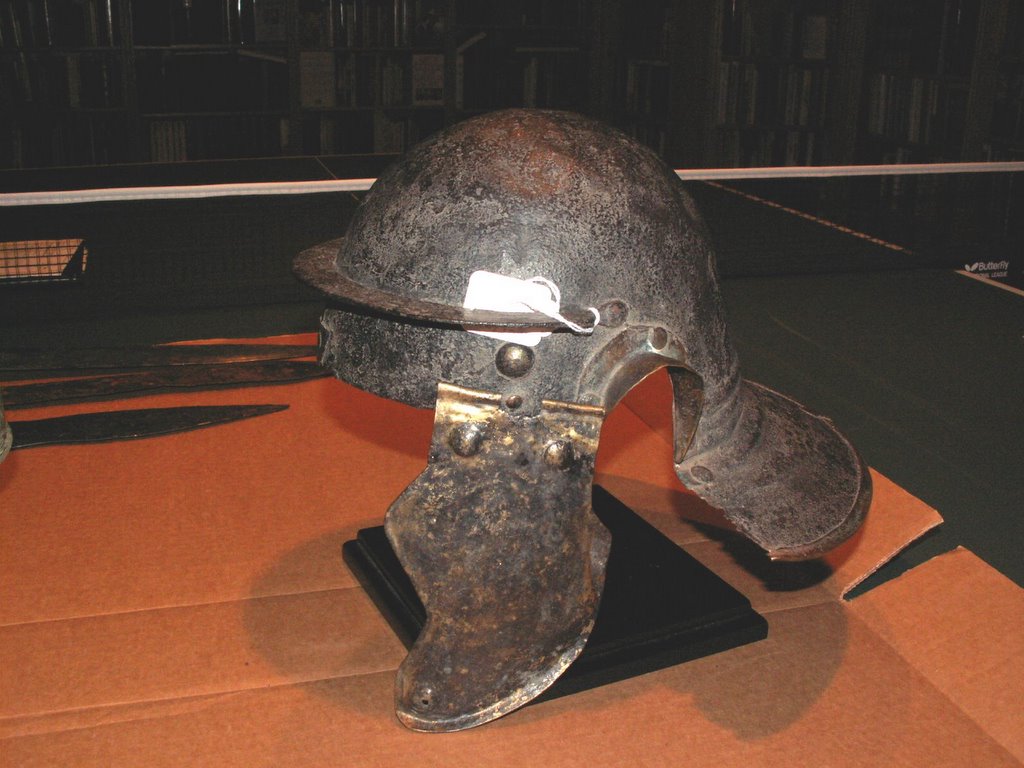
November 12-13 I'll be preaching on this passage. I think the title will be "Armed and Victorious" -- This passage on "spiritual warfare" will tie in to the Veteran's Day Observance we're having. We are all in a battle together. Feel free to share your thoughts on the passage. I'll post my notes later (probably after that weekend). The photo on the left is of an authentic Roman helmet from the 2nd or 3rd Century. I took the photo while viewing the armor collection of a member of our church. For some reason he didn't want me to take it home with me.
Welcome to My Blog Site!

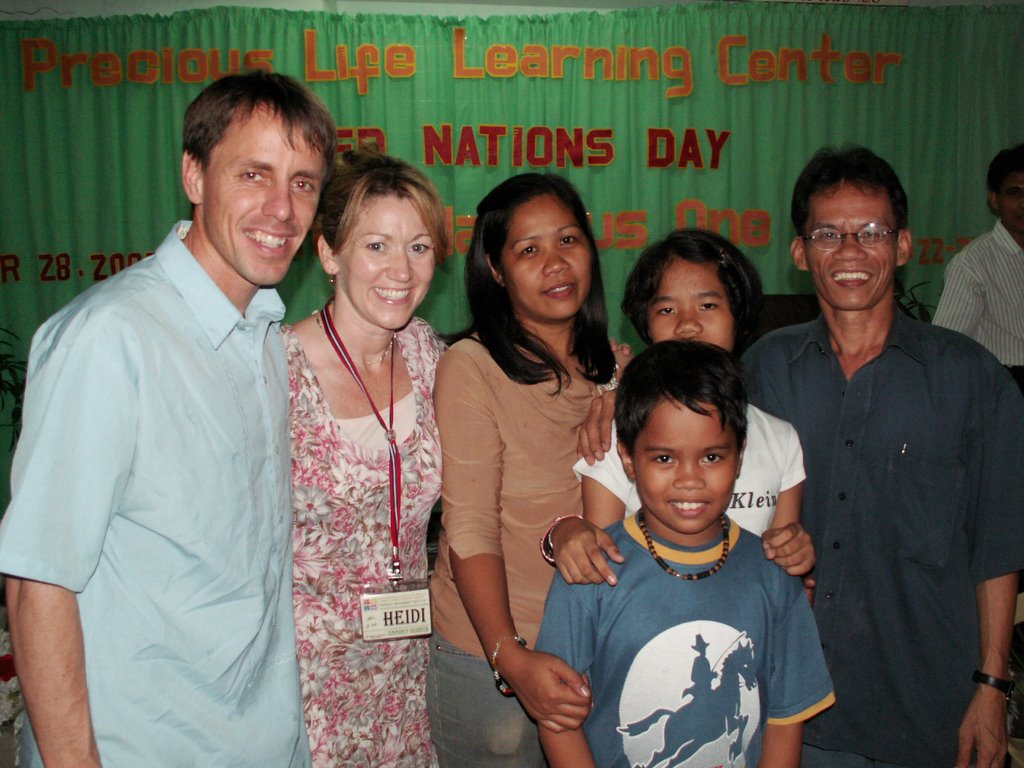
My hope is that this webpage would be useful, thought provoking and a fun place to interact over important issues pertaining to ministry, as well as sharing more of my personal life with those that may be interested. Coming soon: Thoughts from Bangkok and Manila, sermon notes, and a cross country update.
Women In Ministry
Theme: Women in Ministry: Should women be allowed to teach, preach and be ordained in the Church? What is the theological basis for your view?
Personal Introduction
I was in our church lobby between services when a man approached me, shaking his head and staring at our church bulletin. “You mean that you have women pastors here?” “Yes”, I replied, “Our Senior Pastor’s wife is in fact the co-pastor of the church.” “See, I told you” interjected the man’s wife. “We like this church a lot,” continued the man, “but I had no idea you had women pastors.” I tried to assure him that this could be biblically explained, but I was unclear about the textual and cultural explanations that I had been taught. This conversation was similar to other conversations that I had had, and certainly would have throughout my ministry. I knew that this was especially true since I am married to a woman who is ordained and has a strong sense of calling to pastoral leadership and teaching. These are some of the factors that motivated me to write this article. I want to examine the subject of women being involved in Christian leadership and what degree of leadership is appropriate for them to be involved in. I will examine the different views regarding this issue as well giving a brief summary of the New Testament account of women in leadership. I want to give particular attention to the passages of Scripture that have been the primary cause of disagreement over this issue. I also will be relating this subject to the International Church of the Foursquare Gospel, which is the denomination that I am a part of.
Foursquare Position
The denomination to which I belong was founded by a woman. During the 1920s to the early 1940s Aimee Semple McPherson preached to huge crowds around the United States and in Canada. She regularly preached 21 times each week at Angelus Temple (the church that she started). The revivals that she led were characterized by salvations, dramatic healings, and the manifestations of the gifts of the Spirit. She ended up founding and pastoring a church (Angelus Temple) in Los Angeles, that ministered to well over 10,000 people each week. The ministry there included a Bible College and the first Christian radio station. She was unconventional and very popular. Besides being a woman, but she also did not fit the legalist mold common to the Pentecostals of her day (she wore makeup, had short hair, and she had experienced the tragedy of divorce). She was famous for her use of elaborate dramatic presentations and illustrated sermons in her communication. She had no intention of starting a denomination, but as people responded to the Gospel and were discipled and trained, new churches began being planted. Originally the number of women pastors in Foursquare was quite high. Three-fourths of the institute’s first students were women. Fourteen of the first sixteen graduates were women. The dean of the college was a woman. Currently one third of all active credentialed Foursquare ministers are women.[i] Sister McPherson (as she was called) didn’t spend much time defending her position of leadership as a woman. Her ministry was motivated by a deep sense of personal calling (“God has called me to preach this message.”). She frequently made reference to Joel 2:28-29, as well as the example of other women in the Bible. She did not feel that it was necessary to defend her position, since she was convinced that she was merely obeying God.
Today, women serving in official Foursquare ministry and leadership, have been endorsed and encouraged by statements approved and passed as sanctioned Foursquare resolutions. The 1975 official organization statement, “Women In Public Ministry,” reads:
A close study of the Word of God, both Old and New Testament, indicates that God has seen fit to use women in His service in virtually every way He has employed men.
We, therefore, see nothing that should restrict God-ordained and Spirit-filled ministry of women in any capacity or office of the Church in keeping with the Word of God which guides men and women alike.
A 1988 declaration was unanimously passed by the Board of Directors. It reads:
The present and historical position of the Foursquare Church affirms the biblical truth that women are called of God to a role of leadership and public ministry. We hereby reaffirm and encourage the ministry of women throughout the International Church of the Foursquare Gospel.[ii]
My personal opinion is that the need to reaffirm this position stems from an absence of women in positional leadership in the ICFG. Female Senior Pastors are very rare, although many couples go by the title of “co-pastors”. The number of women “pastors” in Foursquare that preach on a regular basis is extremely small. This is in spite of the statements that Foursquare has recently published to affirm their theological and positional support of women in ministry.
Four Views of Women in Ministry
There are four general views regarding womens’ involvement in leadership in the church.
1. Complementarian/Traditional
This view focuses on the complementary nature of men and women. It uses Genesis 2 and 3 (Adam and Eve, and the fall of man) as the starting point, as well as 1 Timothy 2:9-15 in the New Testament. It affirms that men are meant to lead, women are meant to follow. Therefore women cannot be a pastor, probably cannot be an elder and possibly cannot be a teacher or a leader. In this model of ministry women’s primary roles are with children and other women, as hostesses, serving at potlucks, quilting, and possibly as secretaries in the church.
Complementarians that I interviewed did not see this view as sexist. They saw it as being consistent with the Bible. They claimed their position was one where men and women were of equal value, but with different roles. Still, they were unable to explain why it was acceptable for women to teach Sunday school or to sing in church.
On a positive note this view recognizes the differences between men and women. It reinforces the complementary nature of marriage. On the other hand, to rigidly define roles can also cause problems, and while overemphasizing our differences we can miss our similarities.
2. Egalitarians
This view has an emphasis on the equality of men and women. It begins with Genesis 1:26-28 and Galatians 3:28. Egalitarians would say that women can do anything in the church that men do. In other words, women can be pastors, women can be senior pastors of a staff, women can preach and women can hold any position in the church for which they are gifted and qualified.
The egalitarians that I spoke with expressed strong feelings that they felt women were generally discriminated against in the church. They felt that women needed to be further empowered to be able to function in ministry with greater freedom.
Egalitarians must be careful to recognize and affirm gender differences. In a fear of being politically incorrect it is easy to overlook and not discuss these differences. Ultimately this would lead to androgyny. We should be careful to not forget that men and women are different, and not all women are called to be in the same roles as men.
3. Radical Feminists
This group has a focus on promoting women. They sometimes form women’s churches. They take the liberty to re-write the Bible to make it non-patriarchal and to do away with male texts. They have a reputation for evoking fear in the hearts of men.
4. Egalitarian…but
These people support the egalitarian position theologically but in practice the women are limited in their opportunity to lead. In this view women cannot usually be senior pastors. Opportunities for women end up not being available, are not encouraged and are not promoted. This position is very conflicted and frustrating because statements are made but not supported. Promises are made but not fulfilled. Women in this case feel the most frustrated and the least amount of support. These women may feel taken advantage of and are given very limited opportunities to develop their skills in leadership. Mixed messages dominate in this position. The men that lead in these situations sometimes appear to be controlling, chauvinistic, and threatened.
Today we find women leading most effectively in the complementarian and egalitarian churches. Divisions over this issue are becoming greater. Strengths and weaknesses must be recognized in the extremes of all positions regarding this issue.
Women in the New Testament
It is my conviction that the basis for an ethical view of women in ministry must be found in the Scripture. Consequently, I want to examine some important passages that are used as a basis for defending the different ethical positions regarding women in ministry.
“According to the evidence of the New Testament, the exclusion of women from ecclesiastical ministry is neither in accord with the teaching or practice of Jesus, nor with that of the first century church. The New Testament presents the call of Jesus as universally inclusive…Both the call of Jesus to discipleship and the call to ministerial service in the early Church were universal. They were not restricted by sex, marital status, social class, race or nationality.” [iii]
In the New Testament we see women functioning as disciples, apostles, prophets, deacons, and proclaimers of the good news.
Women were the first preachers of the good news of the resurrection of Jesus to the Christian community. (Matthew 28:7-8). Romans 16:1-2 describes Pheobe as a “servant” of the church of Corinth. This term could refer to a deacon. (diakonos). “Paul’s use of the masculine term, diakonos not only suggests the existence of an order of women deacons, but also that the women were included in the same order as male deacons.” [iv] This term was used to refer to a person with administrative responsibility in the early church and even more often in reference to a minister of God’s word, such as himself. Paul also calls her a helper, or patron, which would indicate that she owns a home in which the church meets and holds a position of honor.
Romans 16:3-16 includes references to several women. It lists twice as many men as women, but commends more than twice as many women as men.
Ø Prisca (Priscilla): -- a fellow minister with her husband, involved in the instruction of another minister, Apollos (Acts 18:26).
Ø Junia: a fellow apostle. A common feminine name. Romans 16:7 “Greet Andronicus and Junias, my relatives who have been in prison with me. They are outstanding among the apostles, and they were in Christ before I was. Junias is a woman. [v]
Ø Philippians 4:2 refers to Eudia and Syntyche who shared in the work of the gospel there “help these women who have contended at my side in the cause of the gospel.”
There were women prophets in the New Testament church. (Philip’s daughters, Acts 21:9). Others were described as proclaimers of the word, the presided in the celebration of the Lord’s supper and were called fellow worker’s of Paul (Romans 16:3 Aquila and Priscilla. This usually referred to one who shares in preaching. 1 Thes. 3:2). Others served as deacons and still others functioned as evangelists. This is in spite of the fact that they were generally subordinate in the Jewish, Hellenstic and Roman societies of their day.
In Paul’s lengthy discussion about spiritual gifts, he never indicates that some gifts are for men and other gifts are for women. Instead Paul teaches that the Holy Spirit gives gifts to every Christian without regard for racial background, economic status or gender, and strictly as the Holy Spirit chooses (see 1 Cor. 12:11). Paul never distinguishes between “male gifts” and “female gifts” nor does he suggest differences in the way gifts should be exercised.[vi]
The structure that kept women out of leadership in the church developed in the 2nd, 3rd, and 4th centuries. This structure was modeled after the Old Testament priesthood in which women were excluded from service. An overall view of the teachings of Paul reveal a progressive (not chauvinistic) attitude about the roles of women in society as well as in ministry.
Summary Statement
“In the New Testament there were not ministries of men and women. There were only ministries of Jesus in which both men and women served…There is nothing inherent in the character of Christian ministry as it is presented in the writings of the New Testament which would give reason for the exclusion of women. On the contrary, the New Testament portrays Jesus treating women as equal human persons. It also portrays women and men serving side by side in the various ministries of the church.”[vii]
So why are women forbidden from teaching in the church? This view is complicated by a couple of passages of the New Testament. Let’s examine the two key passages.
1 Corinthians 14:34-35
“Women should remain silent in the churches. They are not allowed to speak, but must be in submission, as the Law says. If they want to inquire about something, they should ask their own husbands at home; for it is disgraceful for a woman to speak in the church.”
Explanation #1: Questions of Authorship
Many, including Hays, believe that this passage “is an interpolation, not written by Paul but added to his letter by a later scribe or editor, such as the author of the pastoral Epistles”. [viii] They also question this passage because it appears to be inconsistent with the context. When removed the passage reads smoothly.
While this is possible, most of us do not take the liberty to “throw out” passages of Scripture. The passage can also be explained as “a Pauline digression on a specific aspect of church order relevant to the Corinthian church”.[ix] Attempts must be made to reconcile this passage with the rest of the New Testament.
Explanation #2: A Quote and Refutation of the Corinthian Position
This view proposes that verses 34-35 are a quote of the Corinthian position, refuted in verse 36, “Did the word of God originate with you?” Some would say that the sarcastic tone of this verse (vs. 36) invalidates the Corinthian position which is actually being quoted in verses 34-35. This is a possibility, although there is not direct evidence that this is how Paul intended the passage to be read.
Explanation #3: Gender Segregated Services
Many have said that communication between the sexes was disruptive because the men and women sat on different sides of the congregation. Although many use this as an explanation, it has been refuted in the examination of the architecture of the synagogues and the homes that were used in the early church.
Explanation #4: A Digression Regarding a Specific Issue of Church Order.
Some would say that Paul is referring specifically to the one kind of speaking directly addressed in these verses; that of asking questions. It was common in the ancient world for hearers to interrupt teachers with questions, but it was considered rude if the questions reflected ignorance of the topic. Women were uneducated, and it is suggested that they were given a prohibition of silence as a short term solution, to end the disruptive questions. The men were told to instruct their wives at home, and therein gain instruction and education.
Contextual Notes
1 Corinthians 11:2-6 reveals that there was a problem in Corinth where women were casting off traditional veils and thereby apparently not honoring men in the church with the mutual respect taught in Eph. 5:21. Paul plainly is not advocating total silence. This is plainly based on the fact that earlier, in the same letter, he expressed an expectancy that they would pray and prophesy publicly along with the men (please see 1 Corinthians 11:4-5). Therein he had spoken of a proper way for women to speak in the church. The only way of explaining this is to understand that he is dealing with a specific type of speaking. Nothing here refers to teaching. A literal interpretation of this passage, carried to its natural conclusion, would exclude all forms of verbal communication, including singing and teaching Sunday School. “If we insist on a literal, legalistic interpretation, let us then eliminate all women teachers in Sunday School, Bible School, and in schools and churches on the mission field.”[x] Why would it be wrong to have women teaching the adults, but O.K. to have them teaching children? There is no reference here to age. If it is “potentially dangerous” to have women teaching adults, we should in fact be even more careful with our impressionable children.
1 Timothy 2:11-12
“A woman should learn in quietness and full submission. I do not permit a woman to teach or to have authority over a man;’ she must be silent.”
Explanation #1: Better Translation
“take authority”: This rare Greek term is translated in the NIV as meaning to “have authority”. This would mean women are not allowed to have any authority in the church. Other scholars say that this is a stronger term and could accurately be translated as meaning to “seize authority.” Some would even translate this phrase as meaning to “domineer in a murderous way.”[xi]
This would forbid women from “teach(ing) in such a way as to take authority.” This is an explanation that changes the meaning of the passage.
With this explanation, Paul is simply stating that he forbids women from grabbing and usurping authority, as he would have also forbidden any man. There were many power struggles going on in the early church, especially with the influence of false teaching.
Paul is likely dealing with a problem in this church. Apparently some women were involved in this insurrection of power.
Explanation #2: Social Situation
There clearly is a specific situation being addressed which was known by Paul and the readers even though it isn’t explained in the text. 1 Timothy speaks of male false teachers causing problems in the church (1:20, 2 Timothy 2:17). They have introduced dangerous heresies into the Ephesian Church. These false teachers were influencing the uneducated women with their destructive doctrines. If these women had seized authority within the church, they would have injured the church’s witness. In response to this specific problem, Paul calls for specific action. He tells them that they are not to take positions of authority in the church. At the same time he encourages them to learn “in quietness and submission”. It is not hard to imagine how this problem could have developed with this group of new believers and how Paul’s response was appropriate.
Paul’s further reference to Adam and Eve complicates this issue. Is this reference the basis of his point, or a “ad hoc argument to support it.”[xii] Is he saying that all women are more easily deceived than all men? Or, is Paul using Eve as an illustration, to the Ephesian women about the danger that they have fallen into, of being deceived as untrained new believers? In 2 Cor. 11:3, Paul uses Eve as an example of anyone, male or female, who is deceived. Another interesting study that sheds light on the immediate cultural situation is to look at the Gnostic teachings regarding women. These specific teachings glorified Eve (and women in general) as the one possessing superior wisdom because she ate from the tree of the knowledge of good and evil. This verse is used by Paul to expunge that teaching.
Current/Personal Ramifications
This subject has been a source of division within the church (at large). We need be remember to be accepting of one another in spite of our different interpretations or positions. This subject can be argued both ways. Those who agree with the egalitarian position must learn to explain their position and not hesitate to release gifted women to serve within the church. Good leadership is not based on the gender of the leader. All other factors must be the primary considerations (e.g.: training, experience, calling, giftedness, health of their marriage, character issues, etc.).
I began this study with an egalitarian perspective, but with many questions about the Biblical basis for my stance. This study has reinforced the position that I had when I commenced this study. I feel that there is a tremendously superior amount of evidence (Biblically) that is in favor of women being given the opportunity to express leadership in the same roles and positions of leadership in the church as men. If there was ever a time in our history for women to be free to minister, that time is now. My perspective will have a large impact on my ministry as I continue to serve with my wife. The things that I have learned in this study will be helpful in explaining our perspective regarding women in leadership in the church. I also will be able to give women the opportunity to serve in positions for which they are gifted and called.
[i] Women in Leadership Ministry: A Position Statement for the International Church of the Foursquare Gospel. International Church of the Foursquare Gospel. Los Angeles, CA 1998.
[ii] Ibid.
[iii] Ibid.
[iv] Ibid.
[v] Tetlow, Elisabeth. Women and Ministry in the New Testament. Lanham, MD: University Press of America, Inc., 1980. Pg. 120.
[vi] Clouse, Bonnidell and Clouse, Robert G., ed. Women In Ministry: Four Views. Downers Grove, IL: InterVarsity Press, 1989. Pg. 191.
[vii] Tetlow, Elisabeth. Women and Ministry in the New Testament. Lanham, MD: University Press of America, Inc., 1980. Pg. 131
[viii] Hays, Richard B. The Moral Vision of the New Testament. San Francisco, CA: Harper Collins, 1996. Pg. 54
[ix] Hawthorne, Gerald F. and Reid, Daniel G. Dictionary of Paul and His Letters. Downers Grove, IL: InterVarsity Press, 1993. Pg. 590.
[x] Maxwell, L.E. Women in Ministry. Wheaton: Victor Books, 1987. Pg. 100.
[xi] Hawthorne, Gerald F. and Reid, Daniel G. Dictionary of Paul and His Letters. Downers Grove, IL: InterVarsity Press, 1993. Pg. 591.
[xii] Ibid.
Bibliography
1. Cook, Barbara. Ordinary Women—Extraordinary Strength. Cootamundra, Australia: PeaceMakers Ministries, Ltd., 1988.
2. Clouse, Bonnidell and Clouse, Robert G., ed. Women In Ministry: Four Views. Downers Grove, IL: InterVarsity Press, 1989
3. Elliston, Edgar J. Foundations of Leadership, Lesson 9. Lecture Notes. Fuller Theological Seminary. Pasadena, CA, 1998
4. Hawthorne, Gerald F. and Reid, Daniel G. Dictionary of Paul and His Letters. Downers Grove, IL: InterVarsity Press, 1993.
5. Hays, Richard B. The Moral Vision of the New Testament. San Francisco, CA: Harper Collins, 1996.
6. Helgesen, Sally. The Female Advantage. New York: Doubleday, 1995.
7. Maxwell, L.E. Women in Ministry. Wheaton: Victor Books, 1987.
8. McPherson, Aimee. Aimee: Life Story of Aimee Semple McPherson. Los Angeles, CA: Foursquare Publications, 1979.
9. Stokes, Allison. Women Pastors. New York: Crossroads Publishing, 1995.
10. Tetlow, Elisabeth. Women and Ministry in the New Testament. Lanham, MD: University Press of America, Inc., 1980.
11. Women in Leadership Ministry: A Position Statement for the International Church of the Foursquare Gospel. International Church of the Foursquare Gospel. Los Angeles, CA 1998.
Personal Introduction
I was in our church lobby between services when a man approached me, shaking his head and staring at our church bulletin. “You mean that you have women pastors here?” “Yes”, I replied, “Our Senior Pastor’s wife is in fact the co-pastor of the church.” “See, I told you” interjected the man’s wife. “We like this church a lot,” continued the man, “but I had no idea you had women pastors.” I tried to assure him that this could be biblically explained, but I was unclear about the textual and cultural explanations that I had been taught. This conversation was similar to other conversations that I had had, and certainly would have throughout my ministry. I knew that this was especially true since I am married to a woman who is ordained and has a strong sense of calling to pastoral leadership and teaching. These are some of the factors that motivated me to write this article. I want to examine the subject of women being involved in Christian leadership and what degree of leadership is appropriate for them to be involved in. I will examine the different views regarding this issue as well giving a brief summary of the New Testament account of women in leadership. I want to give particular attention to the passages of Scripture that have been the primary cause of disagreement over this issue. I also will be relating this subject to the International Church of the Foursquare Gospel, which is the denomination that I am a part of.
Foursquare Position
The denomination to which I belong was founded by a woman. During the 1920s to the early 1940s Aimee Semple McPherson preached to huge crowds around the United States and in Canada. She regularly preached 21 times each week at Angelus Temple (the church that she started). The revivals that she led were characterized by salvations, dramatic healings, and the manifestations of the gifts of the Spirit. She ended up founding and pastoring a church (Angelus Temple) in Los Angeles, that ministered to well over 10,000 people each week. The ministry there included a Bible College and the first Christian radio station. She was unconventional and very popular. Besides being a woman, but she also did not fit the legalist mold common to the Pentecostals of her day (she wore makeup, had short hair, and she had experienced the tragedy of divorce). She was famous for her use of elaborate dramatic presentations and illustrated sermons in her communication. She had no intention of starting a denomination, but as people responded to the Gospel and were discipled and trained, new churches began being planted. Originally the number of women pastors in Foursquare was quite high. Three-fourths of the institute’s first students were women. Fourteen of the first sixteen graduates were women. The dean of the college was a woman. Currently one third of all active credentialed Foursquare ministers are women.[i] Sister McPherson (as she was called) didn’t spend much time defending her position of leadership as a woman. Her ministry was motivated by a deep sense of personal calling (“God has called me to preach this message.”). She frequently made reference to Joel 2:28-29, as well as the example of other women in the Bible. She did not feel that it was necessary to defend her position, since she was convinced that she was merely obeying God.
Today, women serving in official Foursquare ministry and leadership, have been endorsed and encouraged by statements approved and passed as sanctioned Foursquare resolutions. The 1975 official organization statement, “Women In Public Ministry,” reads:
A close study of the Word of God, both Old and New Testament, indicates that God has seen fit to use women in His service in virtually every way He has employed men.
We, therefore, see nothing that should restrict God-ordained and Spirit-filled ministry of women in any capacity or office of the Church in keeping with the Word of God which guides men and women alike.
A 1988 declaration was unanimously passed by the Board of Directors. It reads:
The present and historical position of the Foursquare Church affirms the biblical truth that women are called of God to a role of leadership and public ministry. We hereby reaffirm and encourage the ministry of women throughout the International Church of the Foursquare Gospel.[ii]
My personal opinion is that the need to reaffirm this position stems from an absence of women in positional leadership in the ICFG. Female Senior Pastors are very rare, although many couples go by the title of “co-pastors”. The number of women “pastors” in Foursquare that preach on a regular basis is extremely small. This is in spite of the statements that Foursquare has recently published to affirm their theological and positional support of women in ministry.
Four Views of Women in Ministry
There are four general views regarding womens’ involvement in leadership in the church.
1. Complementarian/Traditional
This view focuses on the complementary nature of men and women. It uses Genesis 2 and 3 (Adam and Eve, and the fall of man) as the starting point, as well as 1 Timothy 2:9-15 in the New Testament. It affirms that men are meant to lead, women are meant to follow. Therefore women cannot be a pastor, probably cannot be an elder and possibly cannot be a teacher or a leader. In this model of ministry women’s primary roles are with children and other women, as hostesses, serving at potlucks, quilting, and possibly as secretaries in the church.
Complementarians that I interviewed did not see this view as sexist. They saw it as being consistent with the Bible. They claimed their position was one where men and women were of equal value, but with different roles. Still, they were unable to explain why it was acceptable for women to teach Sunday school or to sing in church.
On a positive note this view recognizes the differences between men and women. It reinforces the complementary nature of marriage. On the other hand, to rigidly define roles can also cause problems, and while overemphasizing our differences we can miss our similarities.
2. Egalitarians
This view has an emphasis on the equality of men and women. It begins with Genesis 1:26-28 and Galatians 3:28. Egalitarians would say that women can do anything in the church that men do. In other words, women can be pastors, women can be senior pastors of a staff, women can preach and women can hold any position in the church for which they are gifted and qualified.
The egalitarians that I spoke with expressed strong feelings that they felt women were generally discriminated against in the church. They felt that women needed to be further empowered to be able to function in ministry with greater freedom.
Egalitarians must be careful to recognize and affirm gender differences. In a fear of being politically incorrect it is easy to overlook and not discuss these differences. Ultimately this would lead to androgyny. We should be careful to not forget that men and women are different, and not all women are called to be in the same roles as men.
3. Radical Feminists
This group has a focus on promoting women. They sometimes form women’s churches. They take the liberty to re-write the Bible to make it non-patriarchal and to do away with male texts. They have a reputation for evoking fear in the hearts of men.
4. Egalitarian…but
These people support the egalitarian position theologically but in practice the women are limited in their opportunity to lead. In this view women cannot usually be senior pastors. Opportunities for women end up not being available, are not encouraged and are not promoted. This position is very conflicted and frustrating because statements are made but not supported. Promises are made but not fulfilled. Women in this case feel the most frustrated and the least amount of support. These women may feel taken advantage of and are given very limited opportunities to develop their skills in leadership. Mixed messages dominate in this position. The men that lead in these situations sometimes appear to be controlling, chauvinistic, and threatened.
Today we find women leading most effectively in the complementarian and egalitarian churches. Divisions over this issue are becoming greater. Strengths and weaknesses must be recognized in the extremes of all positions regarding this issue.
Women in the New Testament
It is my conviction that the basis for an ethical view of women in ministry must be found in the Scripture. Consequently, I want to examine some important passages that are used as a basis for defending the different ethical positions regarding women in ministry.
“According to the evidence of the New Testament, the exclusion of women from ecclesiastical ministry is neither in accord with the teaching or practice of Jesus, nor with that of the first century church. The New Testament presents the call of Jesus as universally inclusive…Both the call of Jesus to discipleship and the call to ministerial service in the early Church were universal. They were not restricted by sex, marital status, social class, race or nationality.” [iii]
In the New Testament we see women functioning as disciples, apostles, prophets, deacons, and proclaimers of the good news.
Women were the first preachers of the good news of the resurrection of Jesus to the Christian community. (Matthew 28:7-8). Romans 16:1-2 describes Pheobe as a “servant” of the church of Corinth. This term could refer to a deacon. (diakonos). “Paul’s use of the masculine term, diakonos not only suggests the existence of an order of women deacons, but also that the women were included in the same order as male deacons.” [iv] This term was used to refer to a person with administrative responsibility in the early church and even more often in reference to a minister of God’s word, such as himself. Paul also calls her a helper, or patron, which would indicate that she owns a home in which the church meets and holds a position of honor.
Romans 16:3-16 includes references to several women. It lists twice as many men as women, but commends more than twice as many women as men.
Ø Prisca (Priscilla): -- a fellow minister with her husband, involved in the instruction of another minister, Apollos (Acts 18:26).
Ø Junia: a fellow apostle. A common feminine name. Romans 16:7 “Greet Andronicus and Junias, my relatives who have been in prison with me. They are outstanding among the apostles, and they were in Christ before I was. Junias is a woman. [v]
Ø Philippians 4:2 refers to Eudia and Syntyche who shared in the work of the gospel there “help these women who have contended at my side in the cause of the gospel.”
There were women prophets in the New Testament church. (Philip’s daughters, Acts 21:9). Others were described as proclaimers of the word, the presided in the celebration of the Lord’s supper and were called fellow worker’s of Paul (Romans 16:3 Aquila and Priscilla. This usually referred to one who shares in preaching. 1 Thes. 3:2). Others served as deacons and still others functioned as evangelists. This is in spite of the fact that they were generally subordinate in the Jewish, Hellenstic and Roman societies of their day.
In Paul’s lengthy discussion about spiritual gifts, he never indicates that some gifts are for men and other gifts are for women. Instead Paul teaches that the Holy Spirit gives gifts to every Christian without regard for racial background, economic status or gender, and strictly as the Holy Spirit chooses (see 1 Cor. 12:11). Paul never distinguishes between “male gifts” and “female gifts” nor does he suggest differences in the way gifts should be exercised.[vi]
The structure that kept women out of leadership in the church developed in the 2nd, 3rd, and 4th centuries. This structure was modeled after the Old Testament priesthood in which women were excluded from service. An overall view of the teachings of Paul reveal a progressive (not chauvinistic) attitude about the roles of women in society as well as in ministry.
Summary Statement
“In the New Testament there were not ministries of men and women. There were only ministries of Jesus in which both men and women served…There is nothing inherent in the character of Christian ministry as it is presented in the writings of the New Testament which would give reason for the exclusion of women. On the contrary, the New Testament portrays Jesus treating women as equal human persons. It also portrays women and men serving side by side in the various ministries of the church.”[vii]
So why are women forbidden from teaching in the church? This view is complicated by a couple of passages of the New Testament. Let’s examine the two key passages.
1 Corinthians 14:34-35
“Women should remain silent in the churches. They are not allowed to speak, but must be in submission, as the Law says. If they want to inquire about something, they should ask their own husbands at home; for it is disgraceful for a woman to speak in the church.”
Explanation #1: Questions of Authorship
Many, including Hays, believe that this passage “is an interpolation, not written by Paul but added to his letter by a later scribe or editor, such as the author of the pastoral Epistles”. [viii] They also question this passage because it appears to be inconsistent with the context. When removed the passage reads smoothly.
While this is possible, most of us do not take the liberty to “throw out” passages of Scripture. The passage can also be explained as “a Pauline digression on a specific aspect of church order relevant to the Corinthian church”.[ix] Attempts must be made to reconcile this passage with the rest of the New Testament.
Explanation #2: A Quote and Refutation of the Corinthian Position
This view proposes that verses 34-35 are a quote of the Corinthian position, refuted in verse 36, “Did the word of God originate with you?” Some would say that the sarcastic tone of this verse (vs. 36) invalidates the Corinthian position which is actually being quoted in verses 34-35. This is a possibility, although there is not direct evidence that this is how Paul intended the passage to be read.
Explanation #3: Gender Segregated Services
Many have said that communication between the sexes was disruptive because the men and women sat on different sides of the congregation. Although many use this as an explanation, it has been refuted in the examination of the architecture of the synagogues and the homes that were used in the early church.
Explanation #4: A Digression Regarding a Specific Issue of Church Order.
Some would say that Paul is referring specifically to the one kind of speaking directly addressed in these verses; that of asking questions. It was common in the ancient world for hearers to interrupt teachers with questions, but it was considered rude if the questions reflected ignorance of the topic. Women were uneducated, and it is suggested that they were given a prohibition of silence as a short term solution, to end the disruptive questions. The men were told to instruct their wives at home, and therein gain instruction and education.
Contextual Notes
1 Corinthians 11:2-6 reveals that there was a problem in Corinth where women were casting off traditional veils and thereby apparently not honoring men in the church with the mutual respect taught in Eph. 5:21. Paul plainly is not advocating total silence. This is plainly based on the fact that earlier, in the same letter, he expressed an expectancy that they would pray and prophesy publicly along with the men (please see 1 Corinthians 11:4-5). Therein he had spoken of a proper way for women to speak in the church. The only way of explaining this is to understand that he is dealing with a specific type of speaking. Nothing here refers to teaching. A literal interpretation of this passage, carried to its natural conclusion, would exclude all forms of verbal communication, including singing and teaching Sunday School. “If we insist on a literal, legalistic interpretation, let us then eliminate all women teachers in Sunday School, Bible School, and in schools and churches on the mission field.”[x] Why would it be wrong to have women teaching the adults, but O.K. to have them teaching children? There is no reference here to age. If it is “potentially dangerous” to have women teaching adults, we should in fact be even more careful with our impressionable children.
1 Timothy 2:11-12
“A woman should learn in quietness and full submission. I do not permit a woman to teach or to have authority over a man;’ she must be silent.”
Explanation #1: Better Translation
“take authority”: This rare Greek term is translated in the NIV as meaning to “have authority”. This would mean women are not allowed to have any authority in the church. Other scholars say that this is a stronger term and could accurately be translated as meaning to “seize authority.” Some would even translate this phrase as meaning to “domineer in a murderous way.”[xi]
This would forbid women from “teach(ing) in such a way as to take authority.” This is an explanation that changes the meaning of the passage.
With this explanation, Paul is simply stating that he forbids women from grabbing and usurping authority, as he would have also forbidden any man. There were many power struggles going on in the early church, especially with the influence of false teaching.
Paul is likely dealing with a problem in this church. Apparently some women were involved in this insurrection of power.
Explanation #2: Social Situation
There clearly is a specific situation being addressed which was known by Paul and the readers even though it isn’t explained in the text. 1 Timothy speaks of male false teachers causing problems in the church (1:20, 2 Timothy 2:17). They have introduced dangerous heresies into the Ephesian Church. These false teachers were influencing the uneducated women with their destructive doctrines. If these women had seized authority within the church, they would have injured the church’s witness. In response to this specific problem, Paul calls for specific action. He tells them that they are not to take positions of authority in the church. At the same time he encourages them to learn “in quietness and submission”. It is not hard to imagine how this problem could have developed with this group of new believers and how Paul’s response was appropriate.
Paul’s further reference to Adam and Eve complicates this issue. Is this reference the basis of his point, or a “ad hoc argument to support it.”[xii] Is he saying that all women are more easily deceived than all men? Or, is Paul using Eve as an illustration, to the Ephesian women about the danger that they have fallen into, of being deceived as untrained new believers? In 2 Cor. 11:3, Paul uses Eve as an example of anyone, male or female, who is deceived. Another interesting study that sheds light on the immediate cultural situation is to look at the Gnostic teachings regarding women. These specific teachings glorified Eve (and women in general) as the one possessing superior wisdom because she ate from the tree of the knowledge of good and evil. This verse is used by Paul to expunge that teaching.
Current/Personal Ramifications
This subject has been a source of division within the church (at large). We need be remember to be accepting of one another in spite of our different interpretations or positions. This subject can be argued both ways. Those who agree with the egalitarian position must learn to explain their position and not hesitate to release gifted women to serve within the church. Good leadership is not based on the gender of the leader. All other factors must be the primary considerations (e.g.: training, experience, calling, giftedness, health of their marriage, character issues, etc.).
I began this study with an egalitarian perspective, but with many questions about the Biblical basis for my stance. This study has reinforced the position that I had when I commenced this study. I feel that there is a tremendously superior amount of evidence (Biblically) that is in favor of women being given the opportunity to express leadership in the same roles and positions of leadership in the church as men. If there was ever a time in our history for women to be free to minister, that time is now. My perspective will have a large impact on my ministry as I continue to serve with my wife. The things that I have learned in this study will be helpful in explaining our perspective regarding women in leadership in the church. I also will be able to give women the opportunity to serve in positions for which they are gifted and called.
[i] Women in Leadership Ministry: A Position Statement for the International Church of the Foursquare Gospel. International Church of the Foursquare Gospel. Los Angeles, CA 1998.
[ii] Ibid.
[iii] Ibid.
[iv] Ibid.
[v] Tetlow, Elisabeth. Women and Ministry in the New Testament. Lanham, MD: University Press of America, Inc., 1980. Pg. 120.
[vi] Clouse, Bonnidell and Clouse, Robert G., ed. Women In Ministry: Four Views. Downers Grove, IL: InterVarsity Press, 1989. Pg. 191.
[vii] Tetlow, Elisabeth. Women and Ministry in the New Testament. Lanham, MD: University Press of America, Inc., 1980. Pg. 131
[viii] Hays, Richard B. The Moral Vision of the New Testament. San Francisco, CA: Harper Collins, 1996. Pg. 54
[ix] Hawthorne, Gerald F. and Reid, Daniel G. Dictionary of Paul and His Letters. Downers Grove, IL: InterVarsity Press, 1993. Pg. 590.
[x] Maxwell, L.E. Women in Ministry. Wheaton: Victor Books, 1987. Pg. 100.
[xi] Hawthorne, Gerald F. and Reid, Daniel G. Dictionary of Paul and His Letters. Downers Grove, IL: InterVarsity Press, 1993. Pg. 591.
[xii] Ibid.
Bibliography
1. Cook, Barbara. Ordinary Women—Extraordinary Strength. Cootamundra, Australia: PeaceMakers Ministries, Ltd., 1988.
2. Clouse, Bonnidell and Clouse, Robert G., ed. Women In Ministry: Four Views. Downers Grove, IL: InterVarsity Press, 1989
3. Elliston, Edgar J. Foundations of Leadership, Lesson 9. Lecture Notes. Fuller Theological Seminary. Pasadena, CA, 1998
4. Hawthorne, Gerald F. and Reid, Daniel G. Dictionary of Paul and His Letters. Downers Grove, IL: InterVarsity Press, 1993.
5. Hays, Richard B. The Moral Vision of the New Testament. San Francisco, CA: Harper Collins, 1996.
6. Helgesen, Sally. The Female Advantage. New York: Doubleday, 1995.
7. Maxwell, L.E. Women in Ministry. Wheaton: Victor Books, 1987.
8. McPherson, Aimee. Aimee: Life Story of Aimee Semple McPherson. Los Angeles, CA: Foursquare Publications, 1979.
9. Stokes, Allison. Women Pastors. New York: Crossroads Publishing, 1995.
10. Tetlow, Elisabeth. Women and Ministry in the New Testament. Lanham, MD: University Press of America, Inc., 1980.
11. Women in Leadership Ministry: A Position Statement for the International Church of the Foursquare Gospel. International Church of the Foursquare Gospel. Los Angeles, CA 1998.
Subscribe to:
Posts (Atom)